
Aurelian’s Field Reports
Field Report #1
Knowing what should happen is not the same as making it happen.
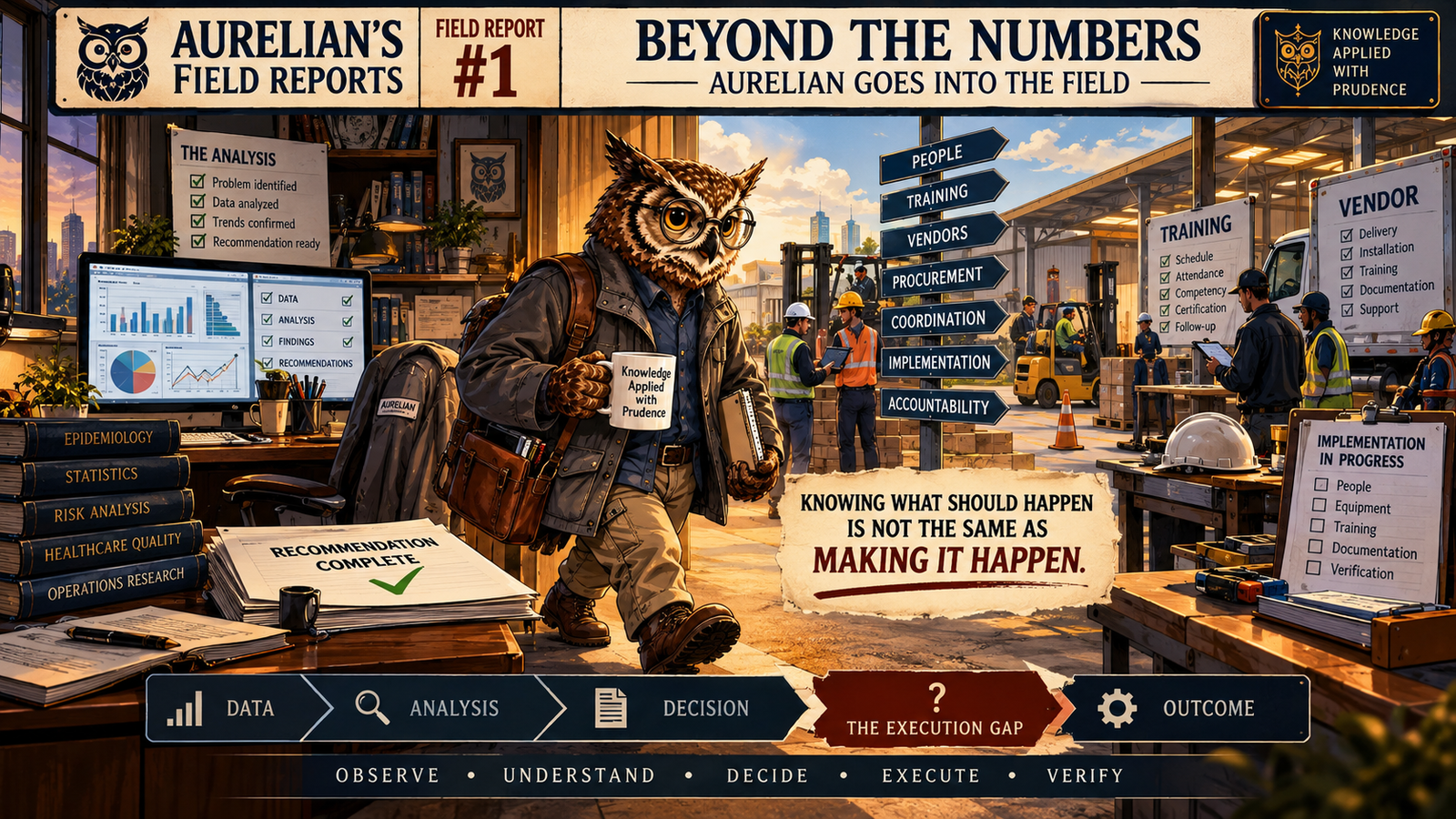
There is a satisfying moment in analytical work when the pieces finally come together.
The data have been collected.
The problem has been identified.
The analysis makes sense.
The recommendation is written.
On paper, the work appears finished.
But organizations do not operate on paper.
Someone still has to make the recommendation happen.
People have to understand what is expected. Resources have to be available. Schedules have to align. Equipment may have to arrive. Vendors may have to perform. Training may have to occur. Documentation may have to be completed.
Someone has to coordinate all of it.
And when something goes wrong, someone has to notice.
Somewhere between decision and outcome, the neat analytical problem becomes an operational one.
That space is where Aurelian’s Field Reports begins.
The Report Is Not the Result
Analysis is extraordinarily useful.
It can reveal a pattern that was previously invisible. It can distinguish a real problem from an assumed one, challenge an intuition, identify a risk, compare alternatives, or show that an organization is not achieving what it believes it is achieving.
But even excellent analysis has a boundary.
A report can identify that employees need training. It cannot attend the training for them.
A dashboard can reveal that a process is failing. It cannot redesign the workflow.
An assessment can identify missing equipment. It cannot purchase, deliver, install, and verify that equipment.
A recommendation can tell management what should happen next.
It cannot make it happen.
The report may be complete while the problem remains completely unsolved.
That distinction sounds obvious when stated plainly.
In practice, completing the analytical work can create a subtle sense of closure.
The problem has been studied.
A meeting has been held.
A decision has been made.
Responsibilities have been assigned.
Perhaps a purchase order has even been approved.
Each of those steps may be necessary.
None of them is the outcome.
The outcome occurs only when the organization successfully converts its decision into reality.
What Lives Between Decision and Outcome
Imagine a relatively simple decision.
An organization determines that a group of employees requires additional training. The analytical question may already be settled. Management agrees that the training is necessary.
Now the operational questions begin.
Who needs to be trained?
What exactly do they need to learn?
Who is qualified to provide the training?
When can employees be released from their normal duties?
What happens to the work while they are away?
Does everyone train at once, or must several sessions be arranged?
What about another shift?
Who schedules the instructor?
Who verifies attendance?
Who maintains the records?
What happens when someone is absent?
And finally:
How does the organization know that the original problem was actually addressed?
None of those questions necessarily requires sophisticated analysis.
But leave even one unanswered, and a reasonable decision can fail to produce the intended result.
Now add outside vendors.
One company supplies the equipment. Another provides the training. Someone internally handles purchasing. Someone else coordinates access to the facility. A supervisor rearranges the work schedule. Another employee collects the documentation. Management becomes involved when something does not arrive on time.
Every participant may complete an individual task correctly while the organization still fails to achieve the complete outcome.
The problem is no longer simply whether each component exists.
It is whether the components work together.
That is the execution gap: the space between deciding what should happen and successfully making it happen.
Inside that gap live people, training, procurement, vendors, schedules, resources, handoffs, communication, documentation, verification, and accountability.
They are not distractions from the analytical problem.
They are part of the problem.
Following the Problem Into the Field
For Prudentia, this raises an interesting question:
What happens if disciplined analysis does not stop when the recommendation is written?
What happens if we follow the problem?
If the numbers indicate a training problem, follow the problem into the training room.
If an organization depends on several vendors to produce one outcome, examine what happens between those vendors.
If a procurement decision looks sensible on paper but creates difficulty in practice, follow the purchase through delivery and implementation.
If management approves a solution that repeatedly fails to materialize, look beyond the decision itself and ask what happens afterward.
That does not mean abandoning the numbers.
It means refusing to stop at them.
The numbers can tell us where to look. The field tells us what happens when we get there.
This is also why Field Reports will sometimes look very different from Aurelian’s Surveillance Files.
The setting may be a warehouse rather than a hospital.
The problem may involve workforce training rather than disease surveillance.
The relevant actors may be supervisors, vendors, procurement personnel, technicians, contractors, managers, or employees simply trying to complete an ordinary day’s work.
The subject changes.
The method does not.
Observe carefully.
Separate what is known from what is assumed.
Understand the system rather than an isolated component.
Look for the mechanism producing the result.
Pay attention to the handoffs.
Follow the consequences.
And perhaps most importantly, verify whether the intended outcome actually occurred.
That is not a departure from analytical thinking.
It is analytical thinking carried all the way into execution.
When Is the Problem Actually Solved?
This may be the most important question in the entire Field Report.
Organizations are very good at documenting activity.
A meeting occurred.
A contract was signed.
Equipment was purchased.
Training was scheduled.
Employees attended.
A new process was launched.
All of those things can be measured.
But activity and outcome are not the same thing.
If training was the intervention, did performance improve?
If equipment was purchased, was it installed, available, and used as intended?
If a workflow was redesigned, did the problem that prompted the redesign actually improve?
If several vendors were responsible for different pieces of the solution, did those pieces ultimately produce the intended result?
Completion is easy to declare when we define completion as finishing a task.
It becomes more demanding when we define it as solving the problem that made the task necessary.
Finishing the work is not always the same as solving the problem.
Aurelian’s Field Report
There will always be value in good analysis.
Organizations need reliable information, sound measurement, and people willing to question assumptions and distinguish evidence from intuition.
But eventually, somebody has to close the spreadsheet.
The recommendation has to leave the report.
People have to act.
Resources have to move.
Vendors have to deliver.
Training has to occur.
Decisions have to survive contact with schedules, budgets, competing priorities, imperfect communication, and the ordinary complexity of getting work done.
That is where an organization discovers whether it merely understood the problem or actually solved it.
Aurelian’s Field Reports will examine that territory—not because analysis has become less important, but because analysis becomes more valuable when we follow it far enough to see what happens next.
Knowing what should happen is not the same as making it happen.
The distance between the two deserves to be examined.
So Aurelian is taking his coffee, leaving the desk, and going into the field.
Field Report #2 — The Cost That Never Appears on the Training Invoice
Discussion
Think about the last significant recommendation made in your organization.
What happened after the decision was made?
Who became responsible for turning it into an outcome?
How many people, departments, vendors, approvals, schedules, and handoffs stood between the recommendation and completion?
And perhaps the more important question:
How did you know when the problem was actually solved?
Where is the execution gap in your organization?
Knowledge Applied with Prudence.