
Aurelian’s Surveillance Files
Field Note #1
Collecting data is only the beginning. What matters is understanding why we collect it—and what we intend to do with it.
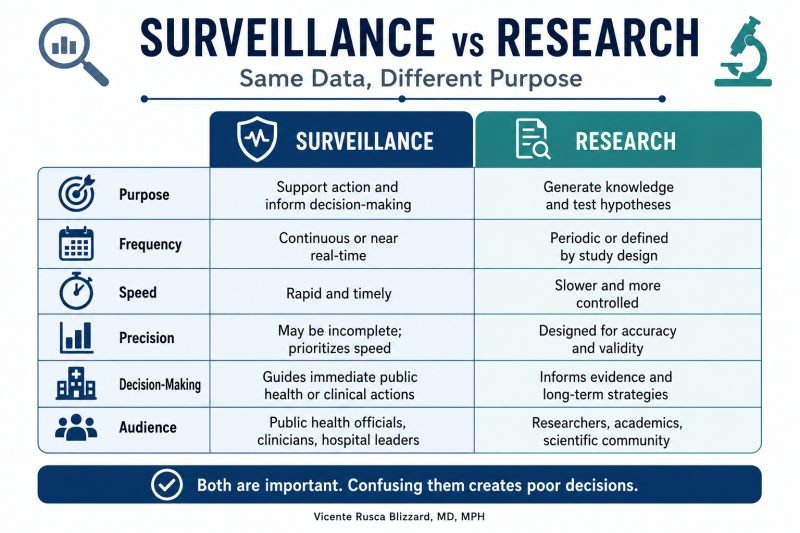
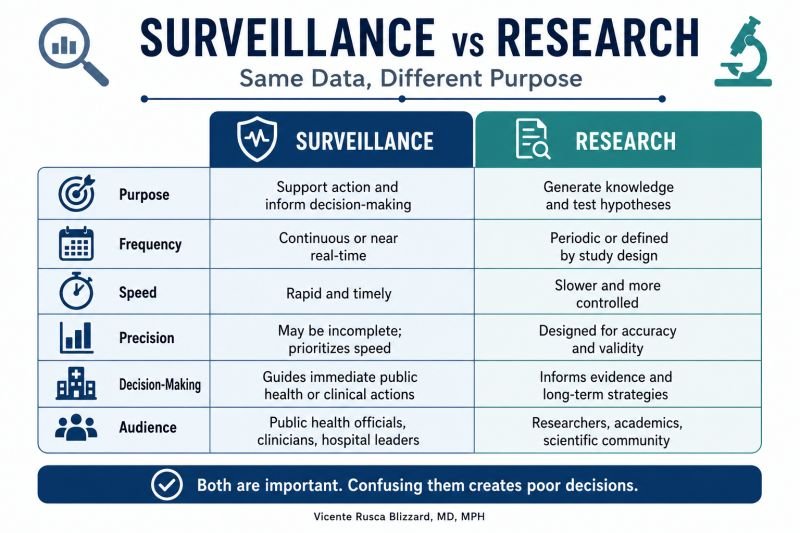
One of the most common misunderstandings in healthcare is the belief that surveillance and research are essentially the same thing.
They are not.
Both involve collecting, analyzing, and interpreting data. Both depend on careful observation and sound methodology. At first glance, they can look remarkably similar.
The difference lies not in the data, but in the purpose.
Understanding that distinction is more than an academic exercise. When surveillance is judged by the standards of research—or research by the expectations of surveillance—we risk misunderstanding both. The result can be unrealistic expectations, misplaced criticism, and missed opportunities to improve public health practice.
The same dataset may support both activities. What changes is the question we are trying to answer.
Two Different Questions
The easiest way to distinguish surveillance from research is to ask what each is trying to accomplish.
Surveillance asks:
“What is happening, and do we need to act?”
Research asks:
“Why is it happening, and what can we learn?”
Both contribute to better healthcare, but they serve different purposes.
Surveillance provides timely information that supports action. It monitors disease occurrence, healthcare-associated infections, adverse events, and other conditions so healthcare professionals can recognize trends, detect unusual events, and respond before problems grow.
Research has a different goal. It seeks to generate new knowledge by testing hypotheses, evaluating interventions, and deepening our understanding of disease, prevention, and treatment.
Neither is superior.
Each answers questions the other cannot.
A Practical Example
Imagine an infection prevention team reviewing healthcare-associated infections each month.
They monitor bloodstream infections, surgical site infections, catheter-associated urinary tract infections, and other reportable events. They compare current rates with previous months, look for unexpected changes, and decide whether additional investigation or intervention is needed.
That is surveillance.
The goal is not to publish a paper.
The goal is to recognize problems early enough to protect patients.
Now imagine a group of researchers analyzing several years of those same surveillance data to determine whether a new infection prevention bundle reduced central line-associated bloodstream infections.
That is research.
The data have not changed.
The purpose has.
Why Surveillance Prioritizes Timeliness
Surveillance systems are sometimes criticized because their data may be incomplete, delayed, or revised as new information becomes available.
Ironically, that criticism often overlooks what surveillance is designed to do.
Its purpose is not to wait until every record has been verified or every uncertainty resolved. Its purpose is to provide reliable information early enough for someone to act.
Case definitions evolve.
Reports arrive at different times.
Laboratory confirmation may still be pending.
If every decision waited for complete certainty, many opportunities to prevent harm would be lost.
In public health, acting with good information today is often more valuable than acting with perfect information tomorrow.
Research follows a different path. It places greater emphasis on methodological control, complete datasets, and minimizing bias before drawing conclusions.
Both approaches are appropriate.
They simply solve different problems.
How Surveillance and Research Work Together
Surveillance and research are not competing activities.
They are partners.
Surveillance identifies questions that deserve investigation.
Research helps answer those questions.
The knowledge gained through research often improves surveillance by refining case definitions, identifying new risk factors, or strengthening prevention strategies.
The relationship is continuous.
Surveillance informs research.
Research strengthens surveillance.
Together, they improve public health.
Why the Difference Matters
Healthcare organizations make countless operational decisions every day.
Should additional infection prevention measures be introduced?
Is an increase in respiratory illness simply seasonal variation, or the beginning of something more concerning?
Does an unusual cluster of infections require immediate investigation?
These decisions cannot always wait for perfect evidence.
Decision-makers need the best information available today, even while additional evidence continues to emerge.
That is precisely what surveillance is designed to provide.
Research supplies the deeper understanding that improves the decisions we make tomorrow.
Knowing when each tool is appropriate allows organizations to use both more effectively.
Common Misconceptions
One misconception is that surveillance data are somehow inferior because they may be incomplete.
They are not.
They are collected for a different purpose.
Their value lies in whether they provide sufficiently reliable information to recognize meaningful patterns and support timely action.
Another misconception is that surveillance should answer every scientific question.
It cannot.
Surveillance identifies patterns.
Research explains them.
Expecting one to perform the role of the other only weakens both.
A Final Thought
One of the most important lessons epidemiology has taught me is that good decisions rarely depend on perfect information.
They depend on having the right information at the right time.
Surveillance provides early awareness.
Research provides deeper understanding.
Neither replaces the other.
Together, they allow us to respond wisely today while learning how to improve tomorrow.
At Prudentia Analytics, we believe that knowledge fulfills its purpose only when it is applied with prudence.
References
- Centers for Disease Control and Prevention. Introduction to Public Health Surveillance.
- World Health Organization. Public Health Surveillance.
- European Centre for Disease Prevention and Control. Data Collection and Surveillance Systems.
Discussion
Have you encountered situations where surveillance data were criticized for limitations that reflected their intended purpose rather than flaws in the system?
How have you helped colleagues distinguish between surveillance and research?