
Aurelian’s Surveillance Files
Field Note #2 — Epidemiologic Silence
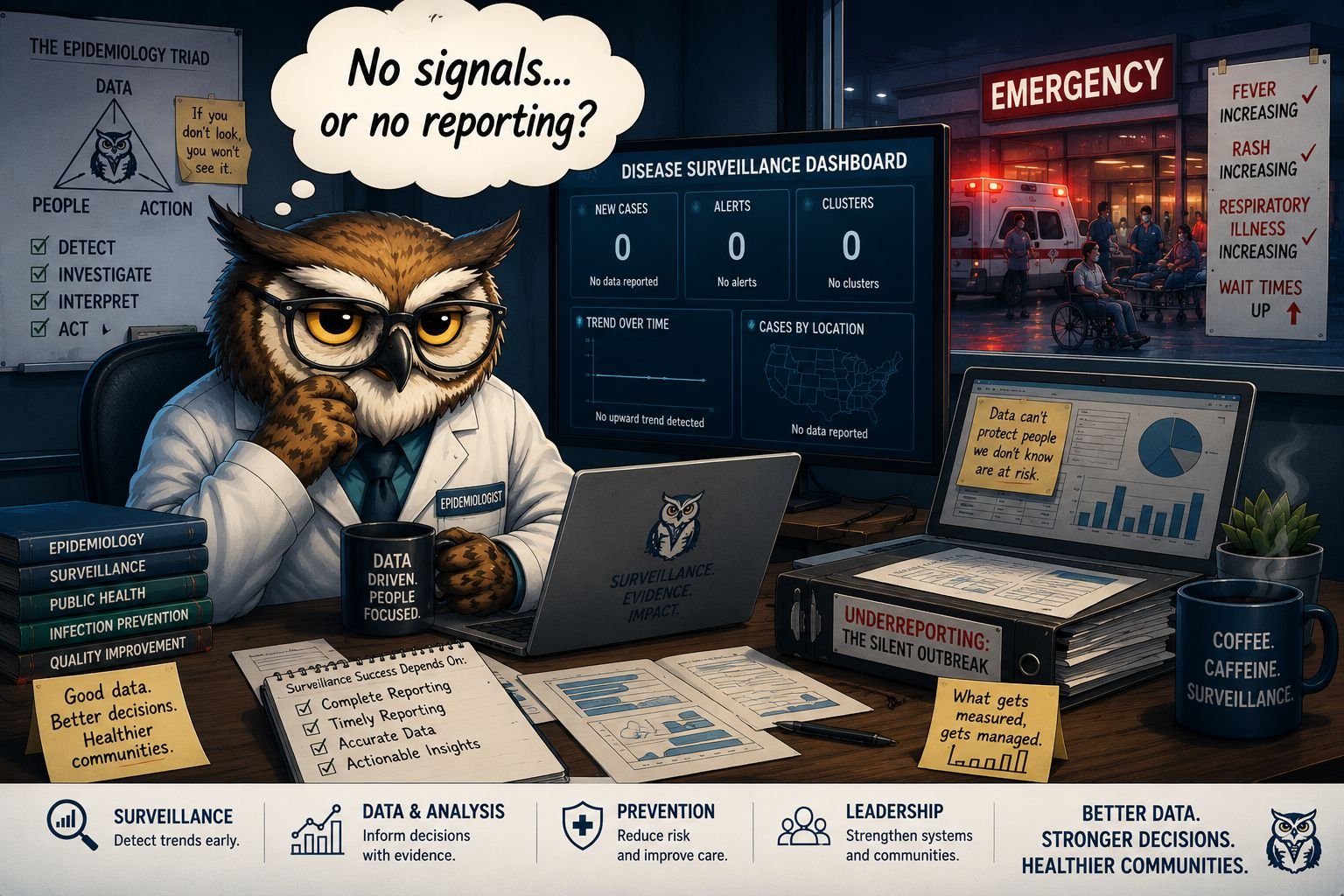
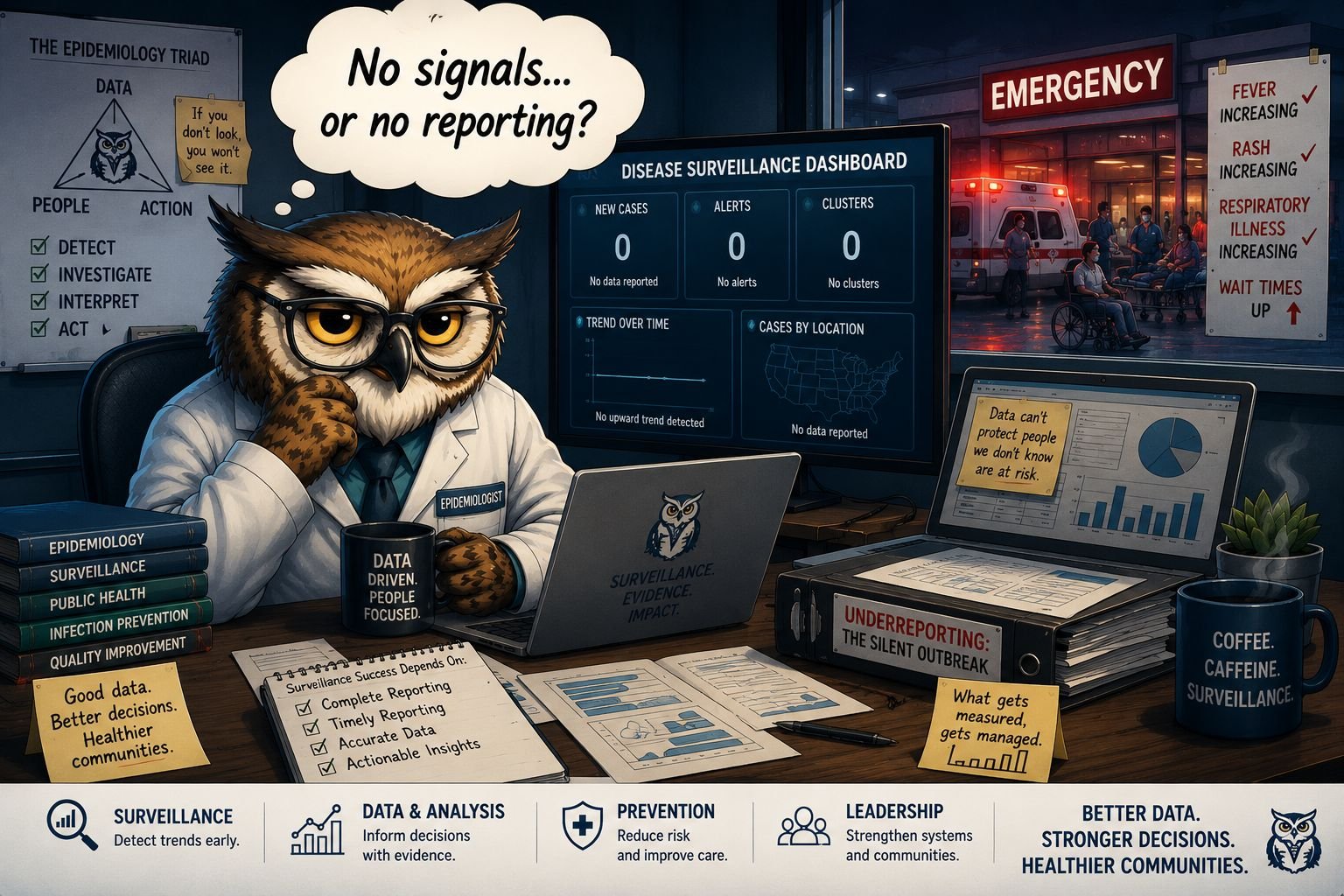
One of the most dangerous messages a surveillance system can send is silence—not because silence proves there is no disease, but because it may conceal the absence of reporting.
Last week, we explored the difference between surveillance and research, emphasizing that surveillance exists to support timely public health action rather than generate scientific knowledge.
But even the most carefully designed surveillance system depends on a simple reality:
Someone must recognize what they are seeing—and decide that it is important enough to report.
Without that first report, there is no trend to analyze, no cluster to investigate, and no signal to alert public health authorities.
That brings us to a concept that deserves far more attention than it often receives:
Epidemiologic silence.
What Is Epidemiologic Silence?
An empty surveillance dashboard can be reassuring.
Zero reported cases.
No alerts.
No unusual events.
Everything appears quiet.
But experienced epidemiologists learn to ask a different question:
Are we seeing no disease—or simply no reporting?
An absence of reported cases does not always mean disease is absent. Sometimes it means cases are going unrecognized, unreported, or never entered into the surveillance system.
The absence of data is not necessarily evidence that nothing is happening.
Sometimes it reflects that no one recognized the event, no one reported it, or the report never reached the surveillance system.
Surveillance Begins at the Bedside
Many people imagine disease surveillance as something that happens in an office filled with dashboards, spreadsheets, and statistical software.
In reality, it begins much earlier.
It begins when a physician recognizes that a patient meets a surveillance case definition.
When a nurse notices an unusual cluster of symptoms.
When a laboratory professional identifies an unexpected pathogen.
When a healthcare worker takes the time to complete a notification form.
Every surveillance system—regardless of how sophisticated it becomes—depends on frontline professionals recognizing that a single patient may represent more than an individual clinical encounter.
That patient may be the first indication of a larger public health event.
Every outbreak begins as a single patient.
One Missing Report Can Change the Picture
It is easy to think of an unreported case as a minor oversight.
Often, it is much more than that.
One missing report becomes missing surveillance data.
Missing data weaken trend analysis.
Weakened trends delay outbreak detection.
Delayed detection postpones intervention.
And delayed intervention may allow additional patients to become affected before preventive measures begin.
Surveillance systems are built one report at a time.
Every report adds another piece to the picture.
Emerging Diseases Rarely Announce Themselves
Emerging infectious diseases seldom arrive with certainty.
The earliest patients often look entirely ordinary.
A fever.
A cough.
Diarrhea.
Seen individually, these cases rarely attract attention.
Seen together, they may represent the beginning of something far more significant.
Many outbreaks have been recognized only because someone noticed a pattern emerging from what first appeared to be isolated events.
That recognition is only possible when those observations become reports.
Timely reporting creates the opportunity for timely action.
Zero Cases Should Raise Two Questions
When reviewing surveillance reports, a dashboard showing zero cases is naturally encouraging.
Sometimes it reflects genuine success.
Sometimes it does not.
Before concluding that disease activity has disappeared, two questions deserve equal attention:
Has disease truly declined?
Has reporting remained complete?
Both matter.
A reduction in reported cases may reflect effective prevention.
It may also reflect staff turnover, reporting fatigue, changes in clinical practice, competing priorities, or uncertainty about surveillance definitions.
Strong surveillance evaluates not only disease activity, but the quality of reporting itself.
Building a Culture of Reporting
Technology can make reporting easier.
It cannot make people report.
Electronic systems are valuable tools, but they cannot replace a culture that recognizes surveillance as a shared professional responsibility.
Organizations can strengthen surveillance by:
- Educate healthcare professionals about reportable conditions.
- Make reporting straightforward and accessible.
- Provide timely feedback to frontline staff.
- Demonstrate how surveillance data improve patient care.
- Encourage collaboration between clinicians, laboratories, infection prevention teams, and epidemiologists.
People are far more likely to participate when they understand that their reports lead to meaningful action.
Reporting should never feel like paperwork completed for its own sake.
It is one of the earliest acts of protecting patients and communities.
Common Misconceptions
One common misconception is that surveillance fails only when incorrect information is reported.
In reality, it can also fail when no information is reported at all.
Another misconception is that surveillance belongs only to epidemiologists.
It does not.
Clinicians, nurses, laboratory professionals, infection preventionists, healthcare administrators, and public health practitioners all contribute to the quality of a surveillance system.
Surveillance is, and always has been, a collective effort.
Key Takeaways
- An absence of reported cases does not necessarily mean an absence of disease.
- Disease surveillance begins with frontline healthcare professionals recognizing and reporting potential cases.
- Missing reports create blind spots that can delay outbreak detection and weaken public health response.
- Strong surveillance depends on reliable reporting systems and a culture that values timely reporting.
- When interpreting zero reported cases, consider both disease activity and reporting performance.
A Final Thought
One lesson has remained with me throughout my career.
Good surveillance is not built on dashboards, software, or statistical models.
It is built on communication.
Every surveillance system begins with someone deciding that what they have observed is important enough to report.
That single report may become the first indication of an outbreak, the beginning of an investigation, or the information that allows healthcare leaders to act before more patients are affected.
The next time you see a surveillance dashboard showing no reported cases, resist the temptation to assume everything is quiet.
Instead, ask the question every epidemiologist should ask:
Is there truly no disease… or are we witnessing epidemiologic silence?
At Prudentia Analytics, we believe that knowledge fulfills its purpose only when it is applied with prudence.
- Centers for Disease Control and Prevention. Introduction to Public Health Surveillance.
- World Health Organization. Early Detection, Assessment and Response to Acute Public Health Events.
- World Health Organization. Public Health Surveillance.
Related Field Notes
Discussion
Have you encountered situations where an apparent decline in reported cases was later traced to underreporting rather than a true reduction in disease? What approaches has your organization found most effective in encouraging timely and complete reporting?