
Aurelian’s Surveillance Files
Field Note #3 — Case Definitions Evolve
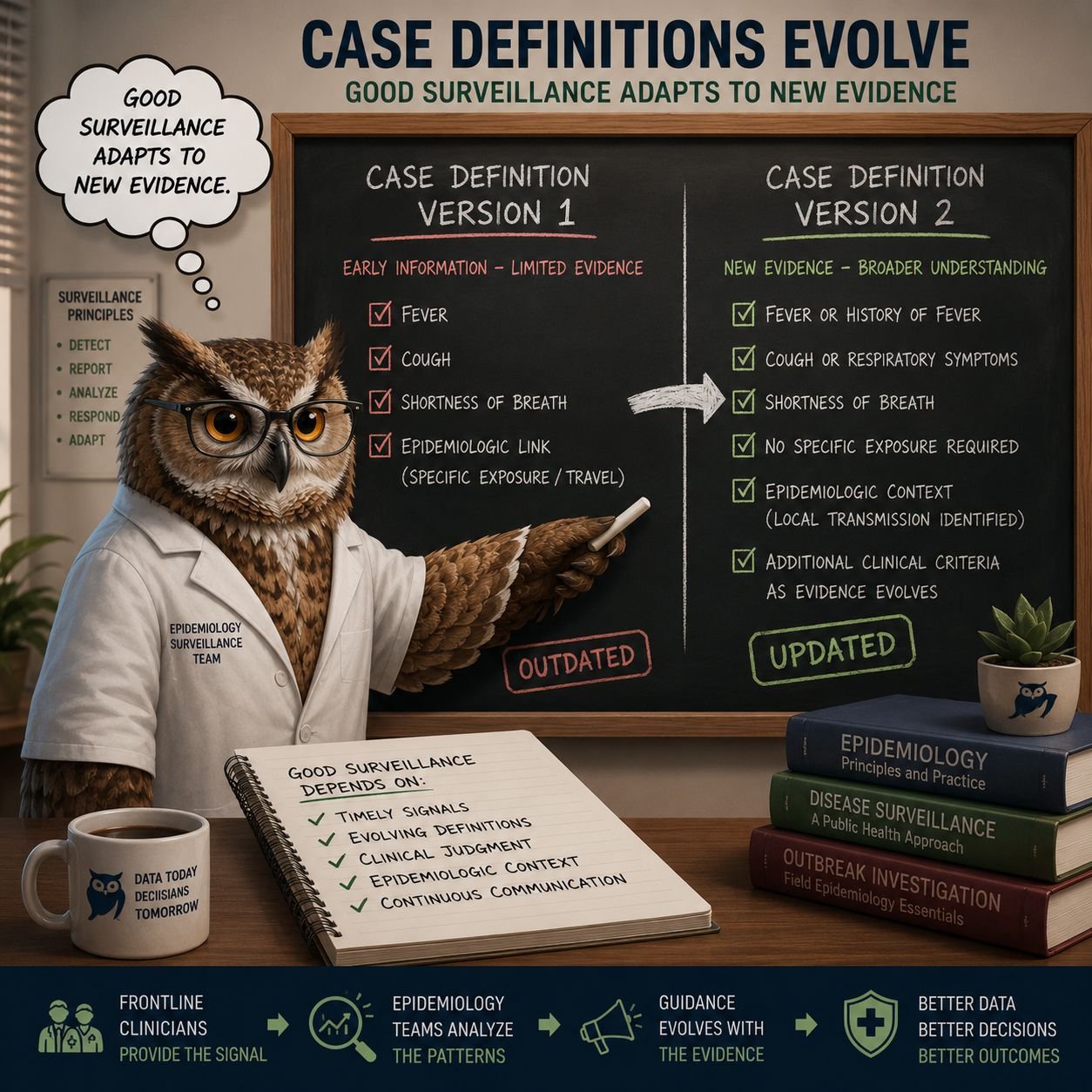
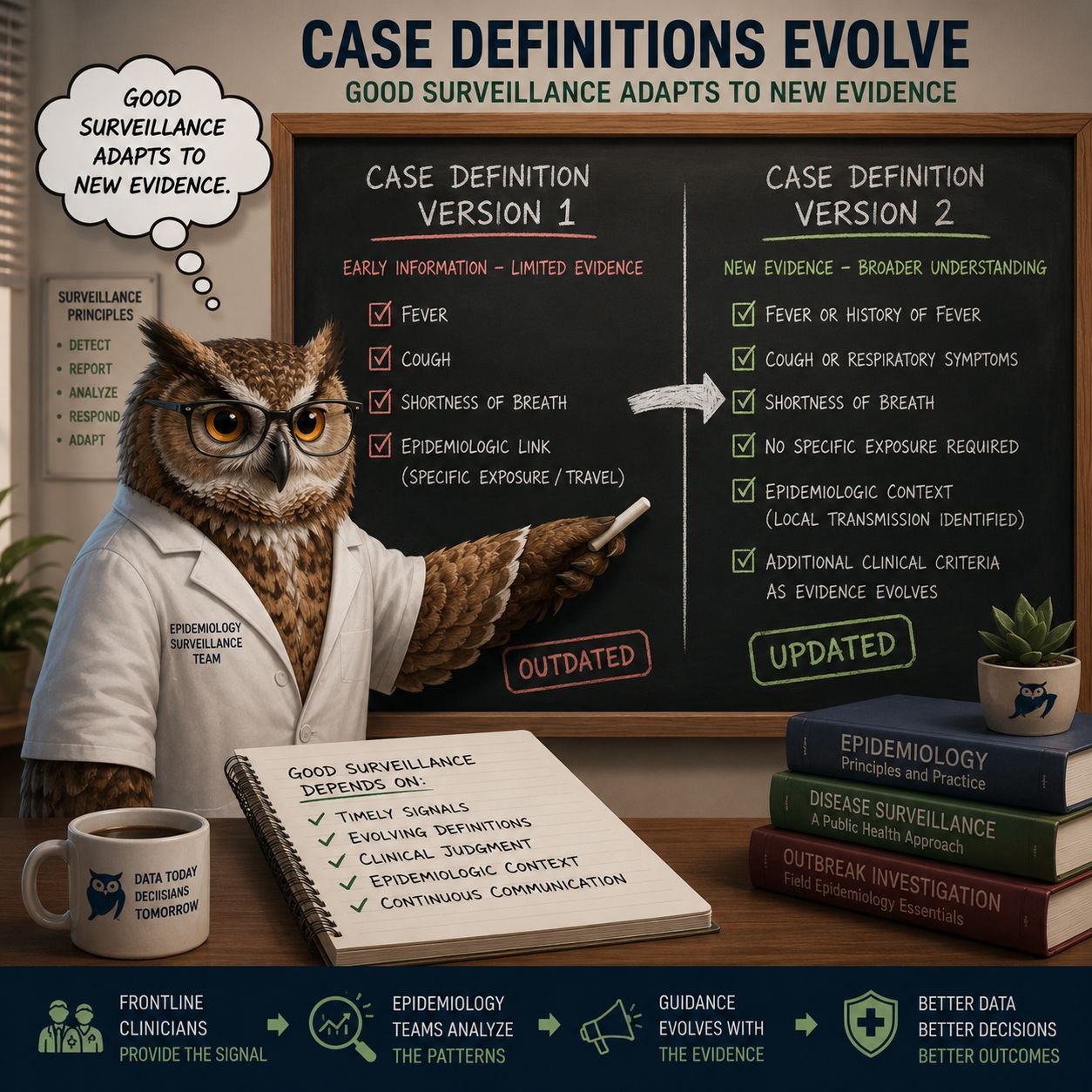
A case definition is not a diagnosis. It is a surveillance tool used to recognize, classify, and monitor disease consistently. Like science itself, it must evolve as the evidence changes.
In the previous Field Note, we examined epidemiologic silence and why an absence of reports does not always mean an absence of disease. Surveillance depends on people recognizing possible cases and reporting them in time.
But that raises another question:
What counts as a case?
The answer lies in one of epidemiology’s most important—and most misunderstood—tools:
The surveillance case definition.
Many healthcare professionals assume that a case definition is a fixed diagnostic rule.
It is not.
A surveillance case definition is a practical standard used to identify and classify cases consistently. As our understanding of a disease changes, the definition may change with it.
That is not a flaw in the system.
It is evidence that the system is learning.
What Is a Surveillance Case Definition?
A surveillance case definition is a standardized set of clinical, laboratory, and epidemiologic criteria used to determine whether a person should be counted as a case for surveillance purposes.
Its purpose is consistency.
When hospitals, laboratories, and public health agencies use the same criteria, reported cases can be compared across locations and over time. This allows epidemiologists to monitor trends, detect outbreaks, and assess whether public health measures are working.
A surveillance case definition is not a substitute for clinical judgment.
A clinician is responsible for the patient in front of them.
An epidemiologist is responsible for understanding what many patients, taken together, may reveal about disease in a population.
Those responsibilities overlap, but they are not the same.
Why Case Definitions Change
When a new disease emerges, the evidence is often limited.
Early definitions may focus on the most obvious symptoms, the clearest exposures, or the laboratory findings that are best understood at the time.
Then the picture begins to change.
New symptoms are recognized.
Transmission becomes clearer.
Risk factors are revised.
Testing improves.
Exposure criteria broaden as the disease spreads.
The definition changes not because the earlier version was careless, but because the evidence has improved.
Good surveillance must be able to learn.
A Lesson from the Front Line
Early in my career, I saw how quickly an emerging infectious disease could outpace an official surveillance definition.
A patient arrived with a clinical picture that strongly suggested a serious emerging infection. The presentation fit the wider epidemiologic situation, yet the patient did not meet every criterion in the definition available at that moment.
The situation was changing rapidly.
Rather than rely on the written definition alone, our team considered the clinical findings, the surrounding epidemiologic context, and the consequences of missing a true case.
We placed the patient under appropriate infection prevention precautions and managed the situation as a suspected case while the evaluation continued.
The patient was later confirmed.
That experience stayed with me.
Case definitions are indispensable, but they should never replace clinical judgment or epidemiologic reasoning.
Structure and Flexibility
Surveillance depends on standardization.
Without consistent definitions, comparisons across hospitals, regions, or countries quickly lose meaning.
But surveillance must also be flexible enough to respond when the evidence changes.
That balance is one of the central challenges of public health practice.
We need structure so that the data remain comparable.
We need flexibility so that the system remains relevant.
Revising a case definition is not an admission of failure. It is a sign that the evidence has changed and the system is responding appropriately.
Science advances by refinement.
Surveillance should do the same.
Communication Matters as Much as the Definition
Updating a case definition is only the beginning.
The revised criteria must reach the people who identify and report cases:
Clinicians.
Nurses.
Laboratory professionals.
Infection preventionists.
Emergency department staff.
Public health agencies.
When communication is delayed or uneven, different parts of the healthcare system may apply different definitions to the same disease.
The result is inconsistent reporting, weaker data, and avoidable confusion.
A sound definition is useful only when it is understood and applied consistently.
Common Misconceptions
One misconception is that a changing case definition means the earlier surveillance effort was flawed.
Usually, it means the science has advanced.
Each revision reflects new evidence and improves the system’s ability to identify cases more accurately.
Another misconception is that surveillance definitions should determine every clinical decision.
They should not.
Clinicians care for patients.
Surveillance systems monitor populations.
The two inform one another, but they are not interchangeable.
Professional judgment remains essential, especially when the evidence is still developing.
Key Takeaways
- Surveillance case definitions provide a consistent way to identify and classify cases. They are designed for population monitoring, not to replace clinical diagnosis. Definitions may change as new evidence emerges. Effective surveillance requires both standardization and adaptability. Clear communication is essential whenever criteria are revised.
A Final Thought
One of the most valuable lessons epidemiology has taught me is that good surveillance must be both disciplined and adaptable.
We need standardized methods to compare data across time and place.
We also need the humility to recognize when those methods must change.
The purpose of surveillance is not to preserve yesterday’s definition.
It is to describe today’s reality as accurately as possible.
As the evidence evolves, our systems should evolve with it.
That is not a weakness of science.
It is one of its greatest strengths.
At Prudentia Analytics, we believe that knowledge fulfills its purpose only when it is applied with prudence.
References
- Centers for Disease Control and Prevention. Principles of Epidemiology in Public Health Practice.
- World Health Organization. Public Health Surveillance.
- Council of State and Territorial Epidemiologists. Public Health Surveillance and Standardized Surveillance Case Definitions.
- European Centre for Disease Prevention and Control. Surveillance Systems Overview.
Related Field Notes
- Field Note #1 — Surveillance vs. Research: Same Data, Different Purpose
- Field Note #2 — Epidemiologic Silence: When No Reports Do Not Mean No Disease
Discussion
Have you experienced a situation in which the evidence changed faster than the formal guidance? How did your team balance standardized procedures with professional judgment while the situation was still evolving?