
Aurelian’s Surveillance Files
Field Note #10
Before disease begins, the conditions for disease are already taking shape.
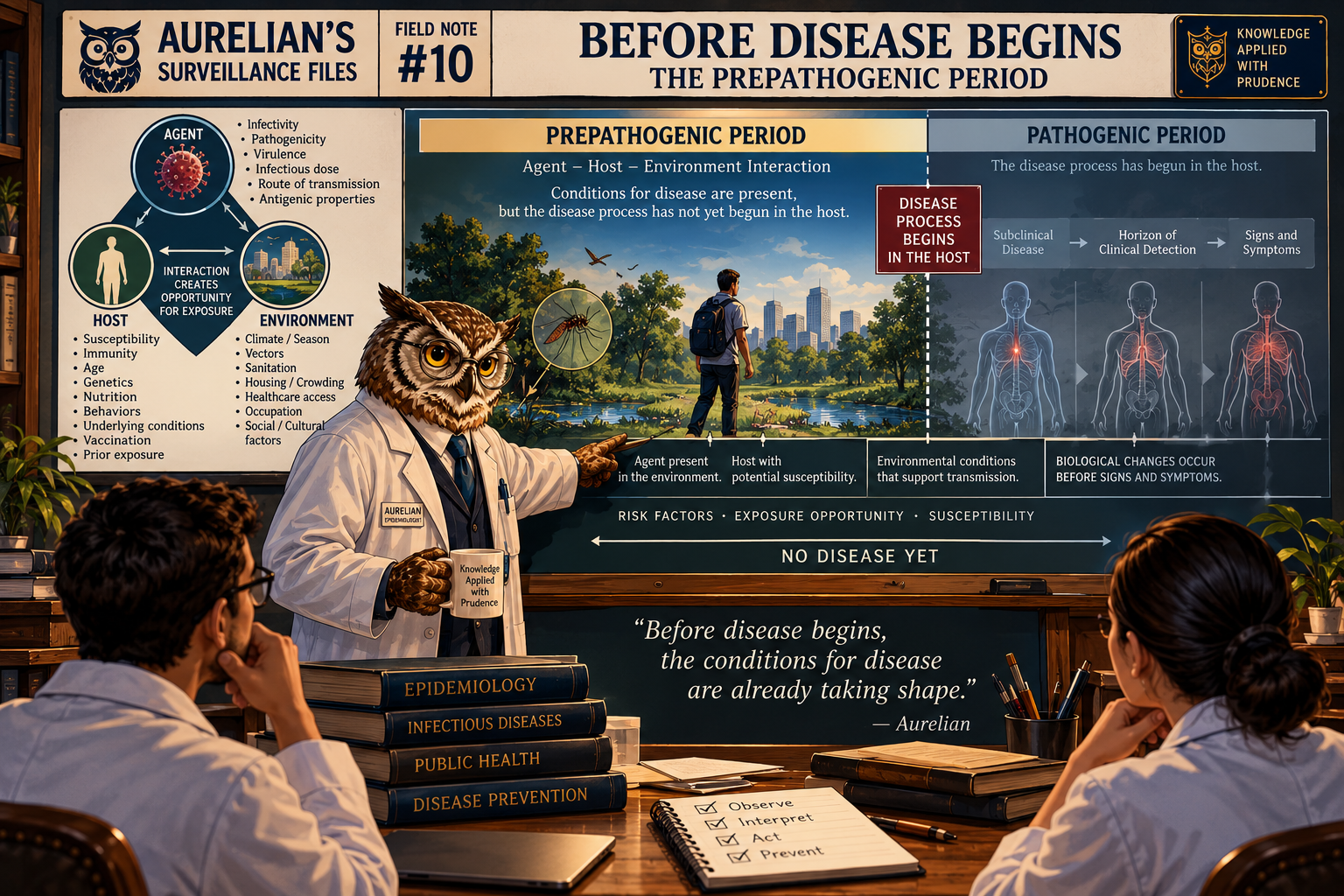
When does disease begin?
It sounds like a simple question.
For many of us, the instinctive answer is when the patient becomes sick: fever appears, pain begins, a cough develops, a laboratory result becomes abnormal, or something else finally tells us that something is wrong.
But the natural history of disease asks us to look further back.
Before the first symptom appears, important events may already have occurred.
And before the disease process itself begins in the host, the conditions that make disease possible may already be taking shape.
This is the prepathogenic period.
The individual has not yet entered the disease process. Yet the characteristics of the agent, the susceptibility of the host, and conditions in the environment may already be influencing what happens next.
In the classical Leavell and Clark framework, this is where the epidemiologic triad begins to unfold across time.
Field Note #9 introduced that triad as a relationship:
Agent ↔ Host ↔ Environment
Now we can put that relationship on a timeline.
Disease Has Not Begun—But the Conditions Are There
Imagine a person going about an ordinary day.
They feel well.
There are no symptoms.
The disease process we are considering has not yet begun in that person.
But epidemiologically, important things may already be happening.
The agent may already exist or circulate in the environment.
The host may have characteristics that influence susceptibility: age, immunity, genetics, nutritional status, vaccination, previous exposure, underlying conditions, or behavior.
The environment may create opportunities for agent and host to interact through climate, vectors, crowding, sanitation, occupation, housing, social conditions, or other circumstances.
The epidemiologic triad from our previous Field Note has not disappeared.
It has become the beginning of the story.
Before disease begins, the conditions for disease are already taking shape.
Consider a mosquito-borne infection.
A susceptible person lives in an area where the pathogen is circulating.
Competent vectors are present.
Seasonal and environmental conditions favor transmission.
And the person is still perfectly healthy.
None of those conditions guarantees infection or disease. They simply create the circumstances in which either may become possible.
That is the prepathogenic period.
Risk Is Not the Same as Disease
This distinction matters.
Having a risk factor is not the same as having a disease.
Being susceptible is not the same as being diseased.
And the presence of an agent somewhere in the environment does not mean that a disease process has already begun in a particular host.
During prepathogenesis, we are looking at the conditions and relationships that precede disease.
The principle extends beyond infectious disease.
A person may have behavioral, genetic, occupational, environmental, or metabolic factors associated with a future disease without currently having that disease.
The causal pathways differ enormously among diseases, and the simple agent-host-environment model cannot capture every detail of modern disease causation.
But it gives us a useful question:
What conditions exist before disease begins, and how are they shaping the probability of what happens next?
That question changes how we think about prevention.
If we wait for symptoms before thinking about disease, we ignore everything that came before the clinical encounter.
Public health often works much farther upstream.
Vaccination can change host susceptibility.
Vector control can change the environment in which transmission occurs.
Sanitation can reduce opportunities for exposure.
Occupational controls can limit contact with hazards.
Health promotion and risk-factor modification can alter conditions associated with the development of disease.
The interventions differ, but they share something important:
They can act before the disease process begins.
That is why the classical natural-history framework places primary prevention in the prepathogenic period.
We will return to primary, secondary, and tertiary prevention in a later Field Note.
For now, remember the larger principle:
Prevention does not have to wait for disease.
Crossing Into Pathogenesis
Eventually, if the necessary interaction occurs, something changes.
The disease process begins within the host.
That boundary takes us from the prepathogenic period into the pathogenic period.
And here we encounter an important distinction.
The beginning of pathogenesis does not necessarily mean the beginning of symptoms.
Biological changes can occur before a person recognizes illness and before clinical signs become apparent. The biological onset of disease and the moment when disease becomes clinically recognizable are not necessarily the same.
Think of the timeline:
Agent–Host–Environment interaction
↓
Prepathogenic period
↓
Disease process begins in the host
↓
Pathogenic period
↓
Subclinical disease
↓
Clinical detection / signs and symptoms
The moment when a clinician first sees the disease may therefore come considerably later than the moment when the biological process began.
A patient may say:
“I became sick yesterday.”
From the patient’s perspective, that may be entirely reasonable.
From the perspective of natural history, however, yesterday may simply be when the disease became apparent.
The biological story may have started earlier.
That distinction becomes enormously important when we begin talking about screening, early detection, incubation, latency, and secondary prevention.
But those belong on the other side of the line.
For Field Note #10, we stop here.
At the boundary.
Symptoms do not necessarily tell us when disease began. They often tell us when disease became visible.
Aurelian’s Field Note
The natural history of disease begins before the patient becomes ill.
Before the disease process begins in the host, conditions affecting what happens next may already exist.
Susceptibility may exist.
Risk factors may exist.
Opportunities for exposure may exist.
Environmental conditions may favor—or inhibit—what happens next.
Yet:
Risk is not disease.
Susceptibility is not disease.
Exposure opportunity is not disease.
The prepathogenic period helps us understand what exists before disease begins.
More importantly, it reminds us that opportunities for prevention may already exist.
Eventually, however, a biological boundary is crossed.
The disease process begins in the host.
And something fascinating may happen:
The patient may still feel perfectly healthy.
That is where Aurelian goes next.
Field Note #11 — Disease Before Symptoms: The Pathogenic Period
References
- Leavell HR, Clark EG. Preventive Medicine for the Doctor in His Community: An Epidemiologic Approach. McGraw-Hill. The Leavell and Clark framework describes the natural history of disease in terms of prepathogenesis and pathogenesis and relates these periods to opportunities for prevention.
- OpenStax. Population Health for Nurses — Epidemiological Approaches. The natural history of disease is described as a progression involving interactions among host, agent, and environment, with the susceptibility/prepathogenesis stage preceding disease development.
- Jewell NP. Natural History of Diseases: Statistical Designs and Issues. Clinical Pharmacology & Therapeutics. 2016;100(4):353–361. The article discusses natural history as the course from immediately before disease inception through presymptomatic and clinical stages to eventual outcomes.
- Application of Disease Etiology and Natural History to Prevention in Primary Health Care: A Discourse. The review discusses natural history as disease progression over time and emphasizes its usefulness for identifying opportunities for prevention across the illness spectrum.
Related Field Notes
- Field Note #8 — When Case Definitions and Medical History Collide
- Field Note #9 — The Epidemiologic Triad: Disease Emerges From Relationships, Not Checklists
Discussion
Think about a disease or health condition you encounter in your own work.
What conditions exist before the disease process begins?
Which belong primarily to the host?
Which involve an agent, exposure, or causal factor?
Which arise from the environment in which those relationships occur?
And most importantly:
Where could prevention act before disease begins?
Knowledge Applied with Prudence