
Agent. Host. Environment. All three may be present—and the outcome can still be different.
Three people live in the same community.
The same infectious agent is circulating.
They experience similar environmental conditions and opportunities for exposure.
One never becomes infected.
Another becomes infected but develops no apparent illness.
A third develops clinical disease.
Why?
At first glance, the classic epidemiologic triad seems almost too simple:
Agent. Host. Environment.
Many of us first encountered the model as a triangle in an epidemiology textbook. Learn the three components, reproduce the diagram on an examination, and move on.
But the triangle becomes far more useful when we stop treating it as a checklist.
The presence of an agent, a susceptible host, and an environment capable of supporting transmission does not guarantee the same outcome in every person.
Exposure does not make disease inevitable.
The epidemiologic triad describes a relationship, and relationships are dynamic.
Change something about the agent, the host, or the environment, and the probability of what happens next may change with it.
That is where the triangle stops being vocabulary and becomes epidemiology.
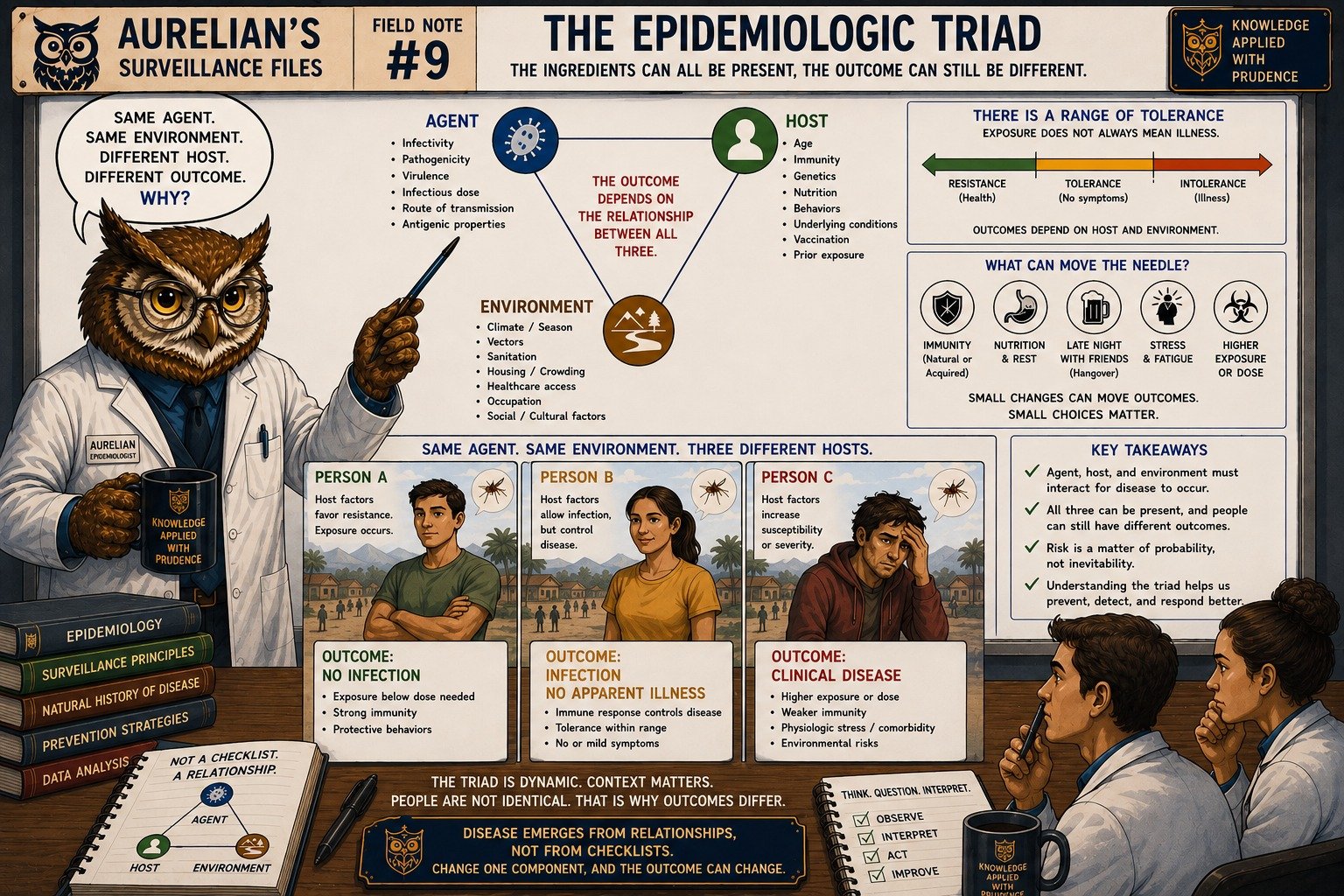
The Triad Is a Relationship
Start with the agent.
For an infectious disease, characteristics such as infectivity, pathogenicity, virulence, infectious dose, route of transmission, and antigenic properties can influence what follows exposure.
But the agent never acts alone.
There is also the host.
Age, immunity, genetics, nutritional status, vaccination, previous exposure, underlying conditions, behavior, and other characteristics may influence susceptibility and the eventual outcome.
Then there is the environment.
Climate, season, sanitation, vectors, housing, crowding, occupation, healthcare access, and social conditions can either facilitate transmission or interfere with it.
CDC describes the epidemiologic triad as the interaction among an external agent, a susceptible host, and an environment that brings the two together. The important point is that these factors do not operate as independent boxes. They influence one another.
The important word is not “and.” It is interaction.
Imagine a mosquito-borne pathogen circulating in a community.
The agent exists.
People capable of serving as hosts exist.
The vector and environmental conditions necessary for transmission exist.
Yet the entire population does not become clinically ill.
Some people may never encounter an infectious vector. Some may be exposed but never infected. Some may become infected without apparent illness. Others may develop recognizable disease, and a smaller proportion may experience severe outcomes.
The three corners of the triangle may therefore be present across the same population while individual outcomes remain remarkably different.
The triangle helps us understand why.
Disease emerges from relationships, not from checklists.
Same Agent. Different Outcome.
Consider three fictional people living within the same general epidemiologic setting.
Person A encounters the agent, but the circumstances favor resistance. Perhaps the effective exposure is insufficient, previous immunity offers protection, or protective behavior interrupts transmission.
The result may be no infection.
Person B becomes infected, but host defenses control the process well enough that no apparent clinical illness develops.
The result may be infection without recognizable disease.
Person C encounters the same agent under circumstances that favor progression to clinical illness. Differences in immunity, underlying conditions, intensity of exposure, physiology, behavior, or environmental circumstances may alter what follows.
The result may be clinical disease.
These examples are deliberately simplified. Real disease processes are more complicated, and different diseases interact with hosts and environments in very different ways.
But the underlying principle is important:
The presence of an agent is not destiny. Exposure is not the same as infection, and infection is not always the same as clinical disease.
Dengue offers a useful example. WHO describes a spectrum ranging from asymptomatic infection to clinically apparent and severe disease. Transmission and risk are also shaped by factors involving the virus, the host, vector ecology, temperature, urbanization, behavior, and the surrounding environment.
Even the same individual is not necessarily the same host from one day to the next.
Our physiological condition changes.
Sleep, nutrition, stress, concurrent illness, medications, immunity, behavior, and many other factors may influence susceptibility or response, although their importance depends on the disease and circumstances.
For that reason, we should be cautious about imagining a universal threshold at which exposure simply becomes disease.
Some diseases have dose-response relationships. Infectious dose matters. Host susceptibility matters. Immune protection matters. Biological thresholds may matter.
But there is no single epidemiologic tolerance line that explains every interaction.
A better way to think about the triad is in terms of probability.
Different relationships create different probabilities of different outcomes.
Why This Matters for Prevention
The epidemiologic triad is useful because it gives us more than one place to intervene.
If prevention depended entirely on eliminating the agent, many diseases would be extraordinarily difficult to control.
Fortunately, we can often alter the relationship instead.
We may act on the agent through treatment, disinfection, sterilization, or other measures that reduce or interrupt the hazard.
We may act on the host through vaccination, nutrition, prophylaxis, protective behavior, or other measures that reduce susceptibility.
We may act on the environment through sanitation, ventilation, vector control, safer housing, workplace protections, better access to healthcare, or changes that reduce opportunities for transmission.
WHO notes that vector-borne disease patterns reflect a complex mixture of demographic, environmental, and social influences, including urbanization, climate, travel, vector adaptation, and community behavior.
Public health interventions often succeed because they alter one part of the relationship enough to change what happens among the others.
Consider vector control.
We do not need to make every human biologically incapable of infection, nor do we need to eradicate a pathogen from existence immediately, to reduce disease.
Changing the environment can reduce opportunities for agent and host to meet.
Vaccination approaches the problem from another direction by changing host susceptibility.
Infection prevention may interrupt the route between them.
Different intervention.
Different corner of the triangle.
Same objective:
Change the relationship so that the probability of disease changes.
That is what makes the triad useful for prevention rather than merely descriptive epidemiology.
Before Disease Begins
There is another implication worth considering.
If disease depends on a changing relationship among agent, host, and environment, then the story begins before the patient becomes visibly ill.
A susceptible host may already exist.
Environmental conditions may already favor transmission.
The agent may already be circulating.
Risk may already be accumulating even though there are no symptoms to detect.
That observation takes us somewhere important.
It takes us from the epidemiologic triad into the natural history of disease.
What happens before the biological disease process begins?
When does exposure occur?
When does the relationship between host and agent change?
When can disease exist without signs or symptoms?
At what point can we detect it?
And perhaps most importantly:
Where can we intervene?
Those questions form the next stage of our journey through epidemiology.
For now, remember what the triangle is actually telling us.
It is not:
Agent ✓
Host ✓
Environment ✓
Therefore: disease.
It is:
Agent ↔ Host ↔ Environment
What happens next depends on the relationships among them.
Change the agent.
Change the host.
Change the environment.
Change the interaction.
And you may change the outcome.
The epidemiologic triad is not a checklist of ingredients for disease. It is a model of relationships that helps us understand why disease occurs—and where we may be able to prevent it.
Aurelian’s Field Note
Exposure does not make disease inevitable.
Agent, host, and environment may all be present while different people experience very different outcomes.
The epidemiologic triad helps us understand why.
Disease emerges from relationships, not from checklists.
And once we understand those relationships, the next question becomes:
What happens before disease begins?
That is where we go next.
References
- Centers for Disease Control and Prevention. Principles of Epidemiology in Public Health Practice, Third Edition: An Introduction to Applied Epidemiology and Biostatistics. Lesson 1, Section 8: Concepts of Disease Occurrence.
- World Health Organization. Vector-borne diseases. WHO describes the distribution of vector-borne diseases as being shaped by complex demographic, environmental, and social factors.
- World Health Organization. Dengue. WHO describes dengue risk and transmission as dynamic and influenced by interactions among the virus, host, vector, environment, urbanization, population movement, and behavior.
- World Health Organization. Guidance on Nature and Health — Vector Control. Environmental conditions and ecosystem changes can influence vector abundance, distribution, and disease transmission.
Related Field Notes
- Field Note #3 — Case Definitions Evolve: Good Surveillance Adapts to New Evidence
- Field Note #7 — The Surveillance Chain: Every Signal Depends on What Happens Next
- Field Note #8 — When Case Definitions and Medical History Collide
Discussion
When thinking about the epidemiologic triad, which part of the relationship—agent, host, or environment—do you think is most often overlooked when people try to explain why disease occurs?
Knowledge Applied with Prudence