
Aurelian’s Surveillance Files
Field Note #8
The case definition asks whether the patient belongs in the surveillance net. Clinical reasoning asks whether the disease actually explains the patient.
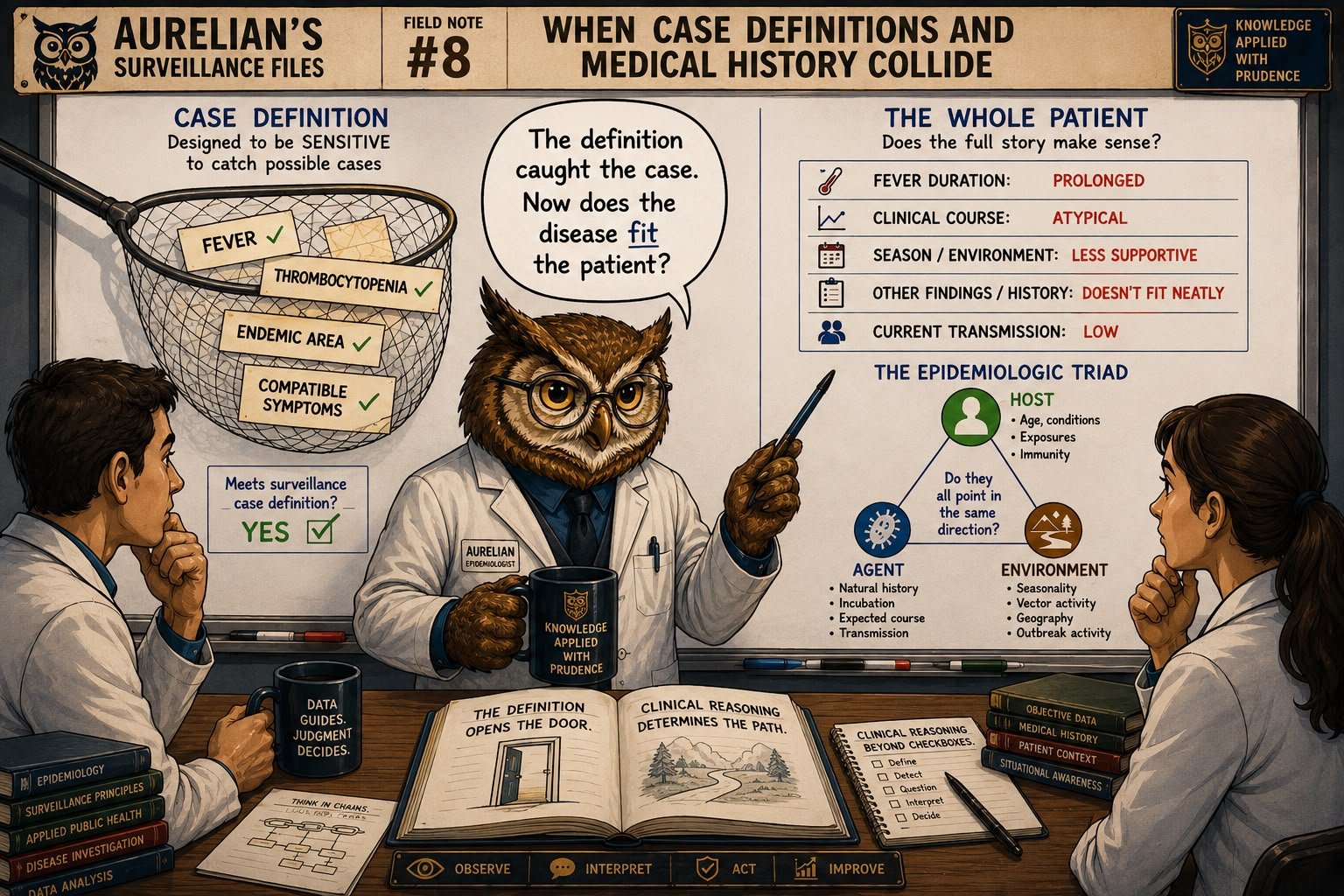
Imagine a clinician working in a region where dengue is endemic.
A patient arrives with fever, thrombocytopenia, and other compatible clinical findings. The surveillance criteria are reviewed.
Several boxes are checked.
Possible dengue.
That conclusion may be entirely appropriate. Depending on the surveillance case definition in use, identifying the patient as a suspected case may be exactly what the system requires.
But then someone keeps reading the medical history.
The fever has persisted longer than expected. The clinical course is unusual. Community transmission is relatively low. Seasonal and environmental conditions are less suggestive than they would be during a period of intense transmission. Other details simply do not fit.
Now the case becomes more interesting.
The patient may satisfy the surveillance criteria.
But does the disease explain the patient?
That distinction is where surveillance and clinical medicine must learn to work together.
Case Definitions Have a Job
Case definitions are fundamental tools of disease surveillance.
They allow clinicians, laboratories, epidemiologists, hospitals, and public health agencies to classify cases using reasonably consistent criteria. Without them, one hospital might define a suspected case one way while another uses an entirely different standard. The resulting surveillance data would quickly become difficult to interpret.
But there is something important about case definitions that can easily be forgotten:
They are designed for a purpose.
Depending on the disease, the circumstances, and the stage of an investigation, a surveillance definition may intentionally emphasize sensitivity.
In practical terms, we sometimes cast a wide net because we do not want potentially important cases to escape detection.
That creates a tradeoff.
A sensitive definition will inevitably capture some patients who ultimately prove not to have the disease under surveillance.
That does not mean the definition failed.
It may mean the definition did exactly what it was designed to do.
It identified something worth investigating.
The problem begins when we confuse being caught by the surveillance net with having established the clinical diagnosis.
The Definition Caught the Case. Now What?
Think of a fishing net.
Its purpose is to catch.
Make the openings too restrictive, and important cases may escape detection. Cast the net more broadly, and some patients who ultimately prove not to have the disease will also be caught.
Surveillance systems manage this balance constantly. Sensitivity and specificity must be considered in light of what the system is intended to accomplish.
But once something enters the net, someone still has to examine what was caught.
The same principle applies to the patient.
A surveillance case definition essentially asks:
Should this patient be considered by the surveillance system?
Clinical reasoning asks something different:
Does this disease adequately explain what is happening to this patient?
The questions are related, but they are not interchangeable.
Neither should make the other disappear.
Read the Whole Story
Clinical medicine begins with something remarkably old-fashioned:
Take a history.
Laboratory results matter.
Case definitions matter.
Surveillance alerts matter.
But so does the timeline.
When did the illness begin?
What happened first?
What happened next?
Is the patient improving, deteriorating, or following an unusual course?
Are there findings the proposed diagnosis does not explain well?
Does the expected natural history of the disease resemble the history sitting in front of us?
This is where diagnostic shortcuts become dangerous.
In an endemic region, clinicians appropriately learn to recognize familiar patterns. That experience is valuable. When a common disease presents with typical findings during a period of active transmission, it deserves serious consideration.
But pattern recognition can gradually become anchoring.
Once we decide that something looks like dengue, for example, we may begin interpreting each new finding through that hypothesis rather than allowing the evidence to challenge it.
The diagnosis begins explaining the evidence instead of the evidence testing the diagnosis.
That is when we need to stop and ask:
Does the whole story still make sense?
Bring Back the Epidemiologic Triad
One of epidemiology’s oldest teaching models remains useful precisely because it forces us to widen our perspective:
Agent. Host. Environment.
When evaluating a suspected disease, all three deserve attention.
Agent
Does the suspected disease behave the way this illness is behaving?
Consider its incubation period, transmission mechanism, expected manifestations, duration, and natural history.
A patient may have several compatible findings while also following a clinical course that is difficult to reconcile with the suspected disease.
That contradiction matters.
Host
Who is the patient?
Age, underlying conditions, immune status, previous illness, medications, exposures, occupation, travel, and other characteristics can influence both susceptibility and presentation.
Diseases occur in people, not in case-definition checkboxes.
Environment
What is happening around the patient?
Seasonality matters. Geography matters. Vector activity may matter. Current community transmission matters. Recent outbreaks, household exposures, and occupational exposures may matter.
None of these factors should dictate the diagnosis on its own. Together, however, they change the epidemiologic plausibility of the hypothesis under consideration.
The question becomes:
Do the agent, host, environment, and medical history point in the same direction?
Sometimes they will.
Sometimes they will not.
When they disagree, that disagreement is not an inconvenience to be ignored.
It is information.
If It Meets the Case Definition, Report It
Now suppose our fictional patient meets the surveillance definition for a suspected dengue case.
Report the case.
That point matters.
If reporting criteria are satisfied, an unusual medical history should not become an excuse to withhold a legitimate surveillance report.
Surveillance systems depend on clinicians and healthcare institutions reporting possible cases according to established criteria—not merely the cases they personally expect will eventually be confirmed.
But reporting a case and establishing a diagnosis are two different decisions.
This is where I use a simple rule:
If it meets the case definition, report it. But don’t marry the diagnosis.
A surveillance classification should open a process.
It should not close the differential.
The patient may appropriately enter the surveillance system as a suspected case while the clinical team continues asking whether the suspected disease actually explains the illness.
If the timeline is wrong, notice it.
If the natural history does not fit, question it.
If the epidemiologic context makes the diagnosis less plausible, take that seriously.
If new findings point elsewhere, follow them.
None of this undermines surveillance.
It is part of using surveillance responsibly.
Surveillance and Clinical Reasoning Need Each Other
Surveillance must remain sensitive enough to detect possible disease.
Clinical reasoning must remain discriminating enough to ask whether the suspected disease truly explains the patient.
Neither discipline benefits from trying to replace the other.
If clinicians disregard surveillance definitions whenever they disagree with them, important cases may go unreported.
If clinicians treat surveillance definitions as final diagnoses, patients may become trapped inside labels that no longer explain their clinical course.
The better approach is straightforward:
Report according to the definition. Diagnose according to the evidence.
The surveillance system needs the signal.
The patient needs continued clinical reasoning.
Both responsibilities can—and should—exist at the same time.
The Most Important Question May Be the Simplest
Healthcare gives us increasingly sophisticated tools:
Laboratory testing.
Electronic surveillance.
Clinical decision support.
Dashboards.
Algorithms.
Case definitions.
Predictive models.
All of them can improve decision-making.
None relieves us of the responsibility to ask whether the conclusion fits the evidence.
Sometimes the most valuable contribution in a difficult case is not identifying the correct diagnosis immediately.
It is recognizing that the current explanation is inadequate.
That recognition reopens the differential. It invites another look at the history, another examination, another question, another possibility.
And sometimes that is exactly what the patient needs.
A case definition can open the door.
Clinical reasoning determines where we go after walking through it.
Clinical judgment does not always tell us what the diagnosis is. Sometimes it tells us that we haven’t found it yet.
Key Takeaways
- Surveillance case definitions and clinical diagnoses serve different purposes.
- A sensitive case definition may appropriately identify patients who ultimately prove not to have the disease under surveillance.
- Meeting a surveillance case definition should trigger the appropriate reporting process without prematurely closing the clinical differential.
- Medical history, natural history, and epidemiologic context remain essential when evaluating whether a suspected disease actually explains the patient.
- Disagreement among the agent, host, environment, and clinical history is not noise. It is information that deserves attention.
If it meets the case definition, report it. But don’t marry the diagnosis.
A Final Thought
Good surveillance depends on recognizing possible disease early enough to act.
Good clinical medicine depends on remaining willing to question whether the first explanation is still the best one.
Those responsibilities are not in conflict.
They protect different parts of the same process.
The case definition asks whether the patient belongs in the surveillance net.
Clinical reasoning asks whether the suspected disease explains the person caught inside it.
Both questions matter.
And perhaps the most important discipline is knowing when one has been answered while the other remains open.
Report according to the definition. Diagnose according to the evidence.
Define. Detect. Question. Interpret.
References
- Centers for Disease Control and Prevention. Principles of Epidemiology in Public Health Practice.
- Centers for Disease Control and Prevention. Surveillance Case Definitions for Current and Historical Conditions.
- World Health Organization. WHO Guidelines for Clinical Management of Arboviral Diseases: Dengue, Chikungunya, Zika and Yellow Fever. 2025.
- World Health Organization. Laboratory Testing for Dengue Virus: Interim Guidance. 2025.
Related Field Notes
- Field Note #1 — Surveillance vs. Research: Same Data, Different Purpose
- Field Note #2 — Epidemiologic Silence: When No Reports Do Not Mean No Disease
- Field Note #3 — Case Definitions Evolve: Good Surveillance Adapts to New Evidence
- Field Note #4 — Syndromic Surveillance: Seeing the Pattern Before Knowing the Diagnosis
- Field Note #5 — Active vs. Passive Surveillance: Sometimes the Best Surveillance Happens Away from the Desk
- Field Note #6 — Sentinel Surveillance: You Don’t Need to Watch Everything—You Need to Watch the Right Things
- Field Note #7 — The Surveillance Chain: Every Signal Depends on What Happens Next
Discussion
When a patient satisfies a surveillance case definition but the medical history does not fit comfortably, how do you balance the obligation to report with the responsibility to keep questioning the diagnosis?
Knowledge Applied with Prudence.
Prudentia Analytics