
Aurelian’s Surveillance Files
Field Note #5 — Active vs. Passive Surveillance
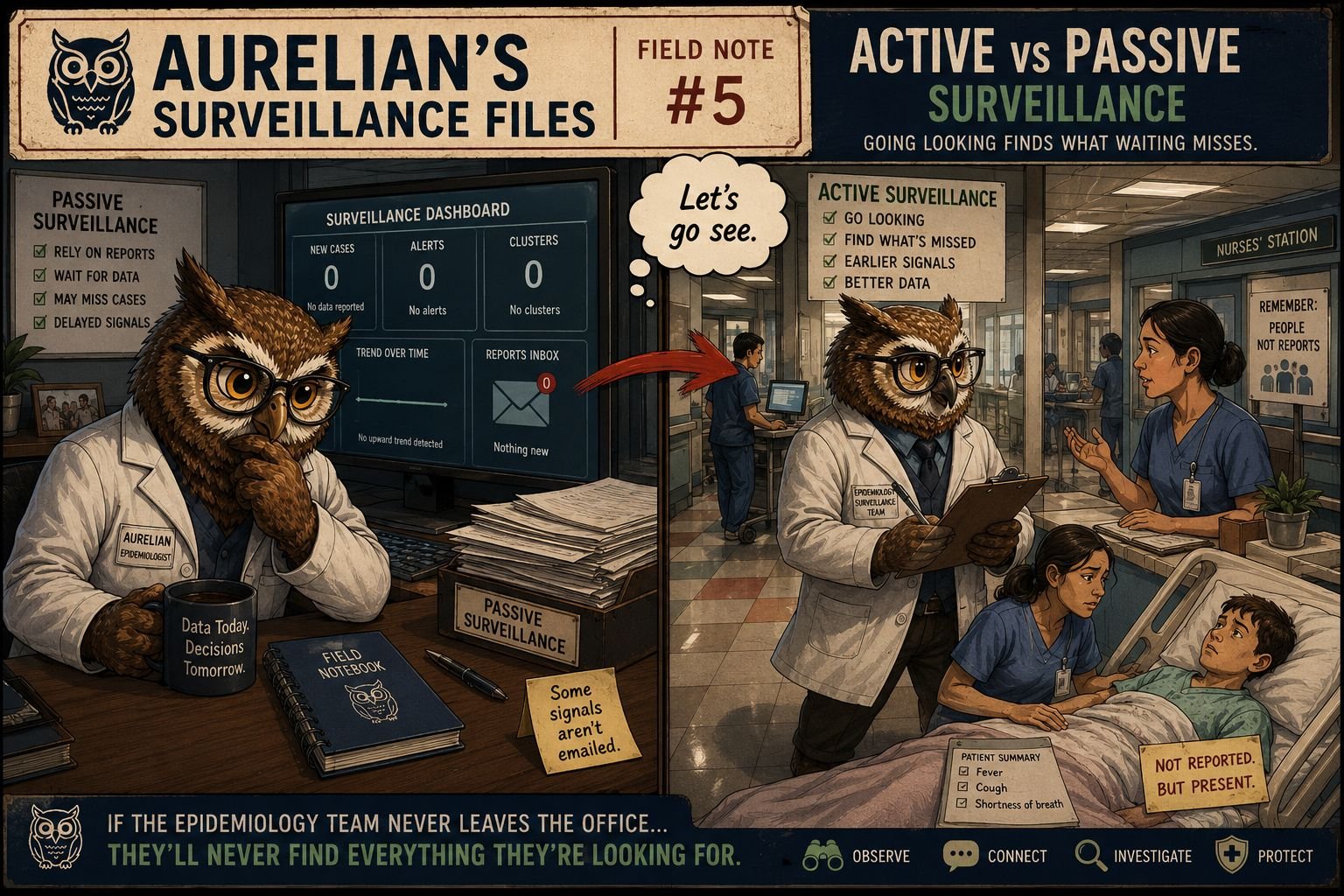
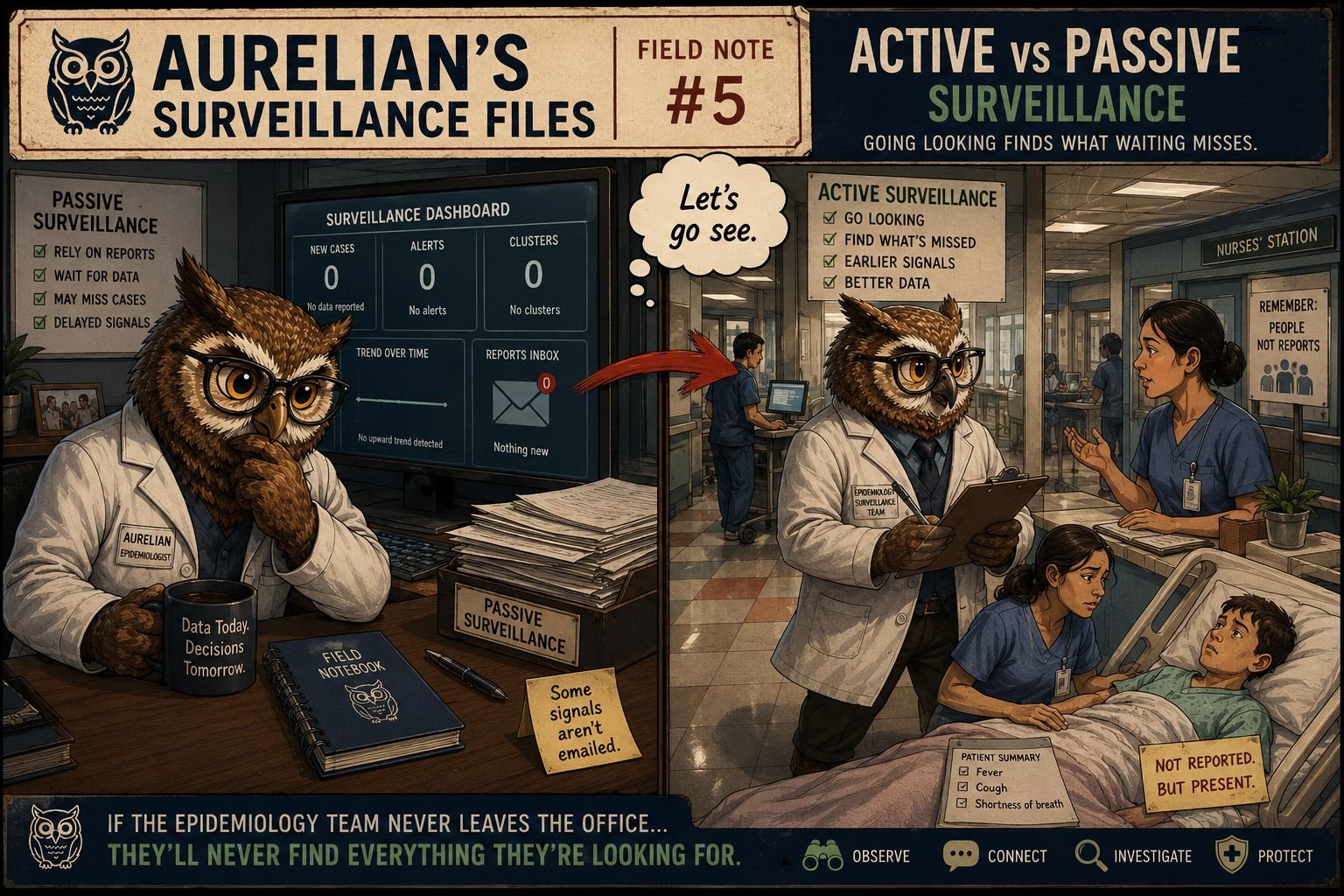
Surveillance does not always come to the epidemiologist. Sometimes the epidemiologist has to go looking for it.
In recent Field Notes, we have looked at how surveillance systems use case definitions to classify disease and how syndromic surveillance can reveal a pattern before a diagnosis is confirmed.
This week, I want to turn to a distinction that has shaped much of my own practice:
Active and passive surveillance.
Most healthcare professionals are familiar with routine disease reporting. A clinician identifies a reportable condition, completes the required notification, and sends the information to infection prevention or public health authorities.
That is passive surveillance, and it remains one of the foundations of modern public health.
But experience teaches another lesson:
Some of the most important surveillance information is never reported.
It has to be found.
Passive Surveillance: The Foundation
Passive surveillance depends on healthcare professionals recognizing reportable conditions and communicating them through established systems.
Clinicians diagnose patients.
Laboratories identify pathogens.
Healthcare facilities submit notifications.
Public health agencies receive the reports, monitor trends, and decide whether further action is needed.
Because it works through existing clinical processes, passive surveillance is practical, efficient, and capable of covering large populations. It allows health systems to monitor disease continuously without requiring epidemiologists to review every patient or record themselves.
Most national and regional surveillance programs rely heavily on passive reporting for precisely this reason.
Without it, monitoring disease across entire communities would be nearly impossible.
The Limits of Waiting
Passive surveillance is essential, but it has a weakness.
It depends on someone recognizing the event, knowing that it should be reported, and completing the process.
If any one of those steps fails, the information may never reach the surveillance system.
A case may be overlooked.
A report may be delayed.
A busy clinical team may understandably give immediate patient care priority over notification.
A healthcare professional may not realize that an isolated event has broader public health significance.
Passive surveillance can only work with the information it receives.
Sometimes, waiting is not enough.
Active Surveillance Changes the Role
Active surveillance takes a different approach.
Rather than waiting for reports to arrive, epidemiologists search for cases and signals directly.
That may involve:
- Reviewing emergency department logs.
- Examining laboratory records.
- Conducting medical record reviews.
- Visiting inpatient units.
- Following up with physicians.
- Speaking with nurses.
- Investigating unusual clinical events.
In active surveillance, the epidemiologist is no longer simply receiving information. The epidemiologist becomes part of the search.
The aim is not to replace passive reporting.
It is to strengthen it.
What the Hospital Teaches
Some of the most valuable lessons I have learned in surveillance did not come from a dashboard.
They came from conversations.
A nurse mentioning that several patients with similar symptoms had arrived overnight.
A physician saying that a presentation “didn’t feel typical.”
A laboratory professional noticing an unexpected increase in specimens for a particular organism.
A visit to a ward revealing something no formal report had yet captured.
These moments taught me a simple truth:
Hospitals often speak through people before they speak through data.
Walking through clinical areas provides context that is difficult to appreciate from an office.
You see how work is actually being done.
You hear concerns before they become formal reports.
You notice changes in workflow.
You build relationships.
Those relationships often become one of the most useful surveillance tools an epidemiologist can have.
Active and Passive Surveillance Work Together
Active and passive surveillance are sometimes discussed as though one must be better than the other.
That is the wrong comparison.
They serve different purposes.
Passive surveillance offers broad, continuous coverage across large populations.
Active surveillance improves completeness, verifies information, identifies missed cases, and provides greater confidence when the stakes are high.
During routine operations, passive reporting may provide enough information.
During an outbreak, the emergence of a new disease, an investigation of healthcare-associated infections, or an event involving a vulnerable population, active surveillance may become essential.
The strength of a surveillance program lies not in choosing one method over the other, but in knowing when each is needed.
Presence Builds Trust
Active surveillance does more than identify additional cases.
It builds trust.
When epidemiologists spend time in clinical areas, healthcare professionals become more comfortable raising concerns.
Questions are asked earlier.
Unusual observations are shared sooner.
Potential problems are discussed before they grow.
Surveillance improves because communication improves.
This benefit is difficult to measure, but it is no less important for being difficult to quantify.
Good epidemiology depends on relationships as much as it depends on methods.
Common Misconceptions
One misconception is that active surveillance simply means working harder.
It does not.
It means working differently.
The purpose is not to collect more information for its own sake. It is to look deliberately in places where important signals are most likely to be found.
Another misconception is that passive surveillance is inferior.
It is not.
Without passive reporting, public health agencies could not monitor disease efficiently across large populations.
The question is not which method is better.
The question is which method the situation requires.
Strong surveillance programs know how to use both.
Key Takeaways
- Passive surveillance depends on cases being reported through established systems.
- Active surveillance requires epidemiologists to search for additional information directly.
- Passive surveillance provides broad and efficient population coverage.
- Active surveillance improves completeness, validates existing reports, and identifies cases that might otherwise be missed.
- Effective surveillance programs use both approaches according to the situation.
A Final Thought
One lesson has stayed with me throughout my career:
If an epidemiology team never leaves the office, it will never find everything it needs to know.
Some signals do not appear on dashboards.
They surface in conversations between colleagues.
They emerge during morning rounds.
They become visible while reviewing a medical record.
They are discovered because someone asks one more question.
Technology has transformed epidemiology, but it has not replaced one of our oldest and most valuable tools:
Being present where care is delivered.
Good epidemiologists analyze data.
The best also understand how that data came to exist.
At Prudentia Analytics, we believe that knowledge fulfills its purpose only when it is applied with prudence.
References
- Centers for Disease Control and Prevention. Principles of Epidemiology in Public Health Practice.
- World Health Organization. Public Health Surveillance.
- European Centre for Disease Prevention and Control. Surveillance Methods and Systems.
- Centers for Disease Control and Prevention. Updated Guidelines for Evaluating Public Health Surveillance Systems.
Related Field Notes
- Field Note #1 — Surveillance vs. Research: Same Data, Different Purpose
- Field Note #2 — Epidemiologic Silence: When No Reports Do Not Mean No Disease
- Field Note #3 — Case Definitions Evolve: Good Surveillance Adapts to New Evidence
- Field Note #4 — Syndromic Surveillance: Seeing the Pattern Before Knowing the Diagnosis
Discussion
How does your organization balance active and passive surveillance in everyday practice? Have you ever discovered an important signal through direct observation or conversation before it appeared in a formal reporting system?