
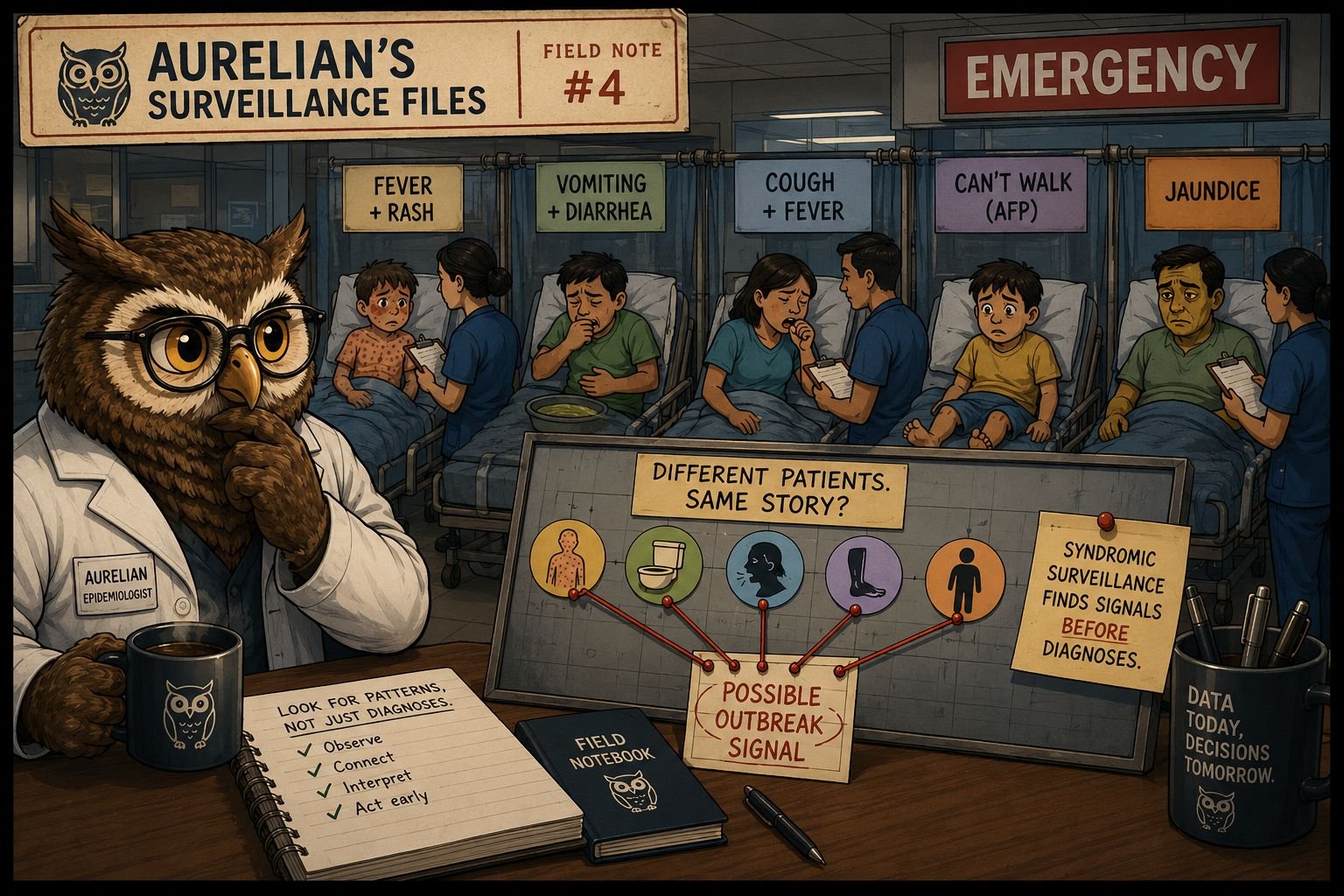
Every outbreak begins with individual patients. Syndromic surveillance helps us recognize when their separate stories are becoming one larger story.
In the previous Field Note, we considered why surveillance case definitions must change as the evidence changes. Good surveillance is not rigid. It adapts as diseases emerge, knowledge improves, and public health priorities shift.
This week, I want to explore a form of surveillance that often surprises clinicians, nurses, and healthcare leaders:
Syndromic surveillance.
Many people assume that disease surveillance begins only after a diagnosis has been confirmed.
Often, it begins much earlier.
Before a laboratory result is available, patients may already be arriving with recognizable combinations of symptoms. Each case may appear ordinary on its own. Seen together, however, those cases may provide the first indication that something unusual is happening.
Syndromic surveillance is the practice of noticing that pattern before the diagnosis is known.
Looking Beyond the Individual Patient
Clinicians are trained to focus on the person in front of them.
An emergency physician evaluates a child with fever and rash.
A pediatrician sees a patient with acute flaccid paralysis.
An internist admits someone with severe respiratory symptoms.
A gastroenterologist treats several patients with acute watery diarrhea.
Each encounter is approached as an individual clinical problem.
The epidemiologist looks at the same events from a different angle.
Instead of asking only,
“What disease does this patient have?”
the epidemiologist also asks,
“Why are we suddenly seeing more patients with the same syndrome?”
That change in perspective lies at the heart of public health surveillance.
What Is Syndromic Surveillance?
Syndromic surveillance is the systematic collection and analysis of health information based on groups of symptoms rather than confirmed diagnoses.
Instead of waiting for laboratory confirmation, a surveillance system may monitor predefined syndromes that could signal a condition of public health importance.
Examples include:
- Fever with rash
- Acute watery diarrhea
- Influenza-like illness
- Acute flaccid paralysis
- Acute jaundice syndrome
- Severe acute respiratory infection
These syndromes are not diagnoses.
They are signals.
Their purpose is to draw attention to patterns that may require investigation.
Why Waiting for Confirmation Can Cost Time
Laboratory testing is indispensable to modern medicine.
It is also rarely immediate.
Specimens must be collected.
Transported.
Processed.
Reviewed.
Interpreted.
During a rapidly developing public health event, that delay may matter.
If surveillance relied only on confirmed diagnoses, the first opportunity to investigate could arrive too late.
Syndromic surveillance helps close that gap.
By monitoring symptom patterns as they appear, epidemiologists can identify unusual activity before the cause is fully understood. This early awareness may allow healthcare organizations to investigate sooner, prepare resources, and introduce control measures before an outbreak expands.
Patterns Matter More Than Isolated Cases
One patient with fever and cough is common.
Ten patients with fever and cough over a short period may suggest increased influenza activity.
Fifty patients arriving within two days may indicate something more serious.
The strength of syndromic surveillance lies not in any one diagnosis, but in the pattern formed by many encounters.
A single case rarely defines an outbreak.
A pattern may reveal one.
For that reason, epidemiologists compare what is happening now with what would ordinarily be expected.
Is the increase unusual?
Is it occurring in one location?
Is it affecting a particular age group?
Did it begin suddenly?
Could the change be explained by seasonality, reporting practices, or healthcare-seeking behavior?
The work lies not simply in noticing change, but in deciding whether that change means anything.
Frontline Professionals Create the First Signal
Epidemiologists may analyze surveillance data, but they do not create the first observations.
Those come from the front line.
Emergency physicians.
Family physicians.
Nurses.
Laboratory professionals.
Paramedics.
Infection preventionists.
Every patient encounter contributes another piece of the picture.
A physician may recognize an unfamiliar syndrome.
A nurse may notice several patients with similar symptoms during the same shift.
A laboratory professional may see an unexpected rise in specimens associated with a particular illness.
Each observation may appear insignificant by itself.
Together, they become surveillance intelligence.
Syndromic surveillance depends on communication between clinical teams and epidemiology services. Neither can work well without the other.
An Early Warning System, Not a Diagnosis
Syndromic surveillance is not intended to confirm a disease.
Its purpose is to ask whether something unusual deserves attention.
Sometimes the answer is no.
An increase may reflect ordinary seasonal variation.
A change in reporting may create the appearance of a new trend.
A busy clinic may simply be seeing the same illness more visibly than before.
But sometimes the signal is real.
The earliest signs of an emerging disease often appear as small changes in routine clinical activity. By the time the pattern is obvious to everyone, the opportunity for early intervention may already have passed.
The challenge is to recognize the signal without mistaking every fluctuation for danger.
That requires vigilance.
It also requires restraint.
Common Misconceptions
One misconception is that syndromic surveillance is unreliable because it does not depend on confirmed diagnoses.
That criticism misunderstands its purpose.
Diagnostic certainty is not the first objective.
Timeliness is.
Syndromic surveillance accepts a degree of uncertainty in exchange for earlier awareness.
Another misconception is that every syndromic signal represents an outbreak.
It does not.
Most signals reflect expected patterns, changes in reporting, or temporary variation. Their purpose is not to create alarm, but to identify events that deserve a closer look.
Good epidemiology knows when to investigate.
It also knows when not to overreact.
Key Takeaways
- Syndromic surveillance monitors groups of symptoms rather than confirmed diagnoses.
- It provides an early warning system for conditions of public health importance.
- Its purpose is to identify unusual patterns before laboratory confirmation is available.
- Frontline healthcare professionals generate the observations that epidemiologists interpret.
- Early recognition may allow health authorities to investigate and respond before an event grows larger.
A Final Thought
One lesson has become clearer to me with every year in epidemiology:
Outbreaks rarely announce themselves.
They begin quietly.
A few additional patients.
An unusual cluster.
A change small enough to dismiss as coincidence.
Syndromic surveillance teaches us to notice those early signs—not because every signal becomes an outbreak, but because every outbreak begins with a signal.
The work of epidemiology is not simply to recognize disease once it is obvious.
It is to recognize the pattern while there is still time to act.
At Prudentia Analytics, we believe that knowledge fulfills its purpose only when it is applied with prudence.
References
- Centers for Disease Control and Prevention. Syndromic Surveillance: An Applied Approach to Outbreak Detection.
- World Health Organization. Early Detection, Assessment and Response to Acute Public Health Events.
- European Centre for Disease Prevention and Control. Syndromic Surveillance Systems in Europe.
- Centers for Disease Control and Prevention. Principles of Epidemiology in Public Health Practice.
Related Field Notes
- Field Note #1 — Surveillance vs. Research: Same Data, Different Purpose
- Field Note #2 — Epidemiologic Silence: When No Reports Do Not Mean No Disease
- Field Note #3 — Case Definitions Evolve: Good Surveillance Adapts to New Evidence
Discussion
Has your organization ever identified an emerging public health concern through a pattern of symptoms before a diagnosis was confirmed? What helped your team distinguish a meaningful signal from ordinary variation?