
Aurelian’s Surveillance Files
Field Note #6 — Sentinel Surveillance
Good surveillance is not measured by how much data we collect, but by whether we collect the right data at the right time to support better decisions.
In recent Field Notes, we have looked at how surveillance systems classify disease, recognize patterns before diagnoses are confirmed, and combine passive reporting with active case finding.
This week, I want to turn to another strategy that is widely used but often misunderstood:
Sentinel surveillance.
When people first encounter disease surveillance, they often imagine the ideal system as one that watches every patient, every hospital, every laboratory, and every community at once.
In theory, that may sound desirable.
In practice, no surveillance system has unlimited staff, laboratory capacity, funding, or time.
Fortunately, effective surveillance does not always require watching everything.
Sometimes, it requires knowing where to look.
What Is Sentinel Surveillance?
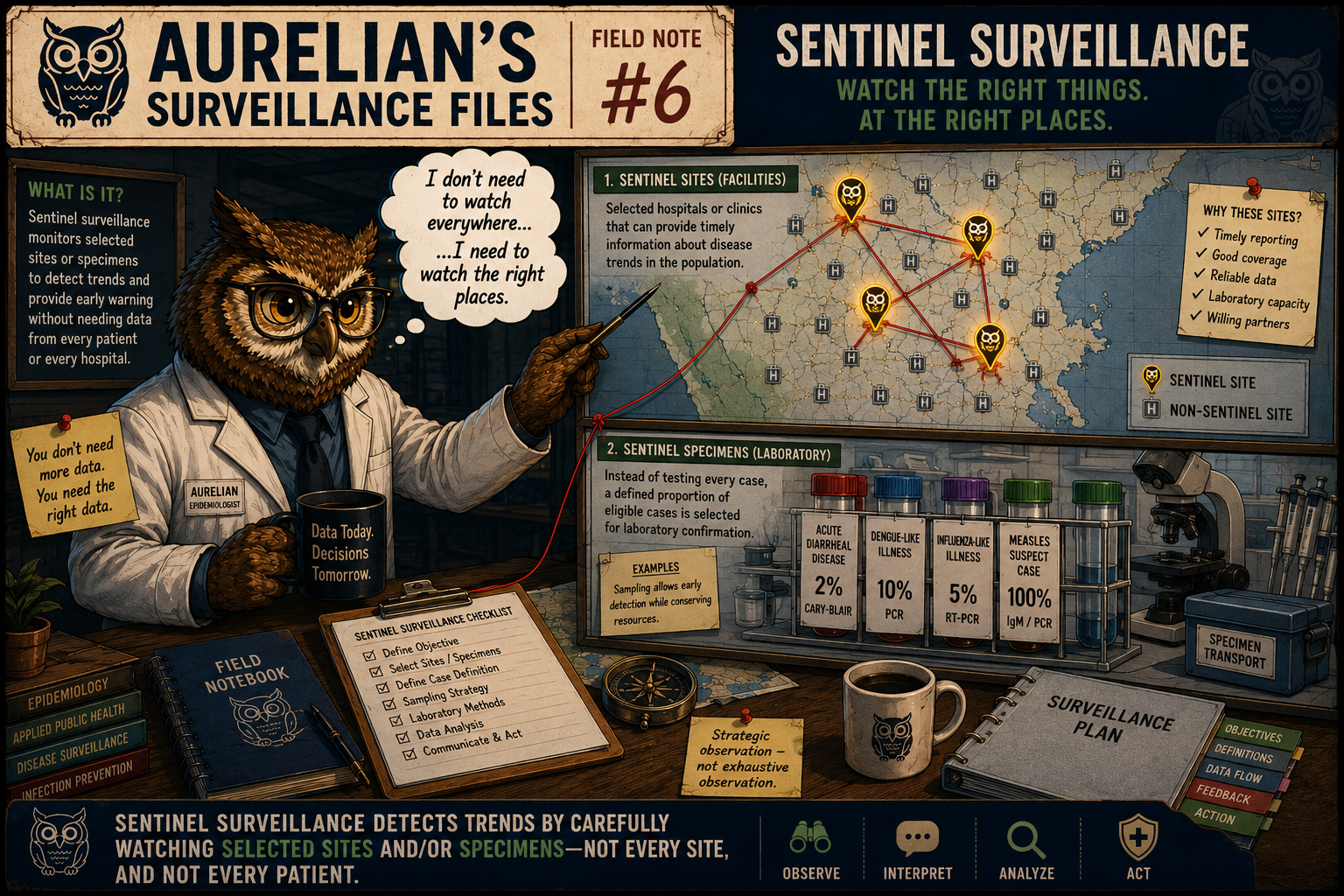
Sentinel surveillance collects information from carefully selected reporting sites rather than attempting to monitor an entire population.
These sentinel sites are chosen because they can provide timely, reliable, and useful information about disease activity.
A sentinel site may be:
- A hospital
- A primary care clinic
- An emergency department
- A public health laboratory
- A physician network
- A specialized surveillance program
Instead of spreading attention everywhere, sentinel surveillance concentrates it where important signals are most likely to appear.
The goal is not complete coverage.
The goal is meaningful observation.
Why Monitor a Sample Instead of Everyone?
At first, monitoring only selected sites may seem inadequate.
Why not collect data from every healthcare facility?
Because high-quality surveillance requires more than a reporting form.
It requires trained staff, laboratory support, standardized procedures, quality assurance, and sustained oversight.
Extending that level of effort to every location may be impractical, unnecessary, or both.
A well-designed sentinel system can reveal important trends while using resources far more efficiently.
In epidemiology, more data do not automatically lead to better decisions.
Better data do.
Sentinel Surveillance in Everyday Practice
Many healthcare professionals take part in sentinel surveillance without realizing it.
Within a hospital, not every patient who meets a clinical syndrome is necessarily tested for every possible pathogen. Instead, a protocol may call for laboratory testing in a defined proportion of eligible patients.
For example:
- Selected stool specimens from patients with acute watery diarrhea may be submitted for cholera surveillance.
- Patients with dengue-like illness may undergo PCR testing according to an established sampling protocol.
- Influenza surveillance often relies on selected clinics that collect respiratory specimens from eligible patients throughout the season.
These programs provide valuable information about circulating pathogens without requiring every patient to receive the same level of testing.
The strength of the system lies not in testing everyone, but in selecting the right patients and applying the process consistently.
Choosing the Right Sentinel Sites
Selecting sentinel sites is one of the most important decisions in the design of the system.
A strong sentinel site should:
- Identify eligible patients consistently.
- Report data promptly.
- Maintain reliable laboratory and reporting practices.
- Reflect the population or condition being monitored.
- Participate steadily over time.
Poorly chosen sites may introduce bias or miss important changes.
Well-chosen sites become trusted windows into the health of a much larger population.
That is why sentinel surveillance requires careful epidemiologic planning. Convenience alone is not a selection strategy.
Quality Over Quantity
One lesson has become clearer to me over the years:
Collecting more information is not the same as collecting better information.
Healthcare organizations often feel pressure to measure everything.
But surveillance systems can become burdened by large volumes of data that contribute little to action.
Sentinel surveillance offers a useful corrective.
A smaller amount of high-quality, representative information may reveal more than a vast amount of inconsistent reporting.
Purposeful observation often outperforms indiscriminate collection.
That principle reaches beyond epidemiology. It applies equally to healthcare quality, infection prevention, and public health management.
Measure what matters.
Measure it well.
Sentinel Surveillance Works Alongside Other Systems
Sentinel surveillance is not a substitute for passive, active, or syndromic surveillance.
It complements them.
Passive surveillance provides broad reporting across populations.
Active surveillance improves completeness through direct case finding.
Syndromic surveillance identifies unusual patterns before diagnoses are confirmed.
Sentinel surveillance provides focused, high-quality information from carefully selected reporting sites.
Each method answers a different question.
Together, they form a stronger surveillance network than any one approach could provide alone.
Good epidemiology depends less on choosing a favorite method than on knowing which method the situation requires.
Common Misconceptions
One misconception is that sentinel surveillance is simply a less complete form of surveillance.
It is not.
Completeness is not its primary aim.
Representativeness, consistency, and timeliness are.
Another misconception is that sentinel surveillance exists only because resources are limited.
Efficiency is certainly one advantage, but it is not the whole purpose. Many respected surveillance programs use sentinel sites deliberately because standardized information from well-chosen locations can support reliable trend analysis over time.
Sentinel surveillance is not about collecting less for the sake of collecting less.
It is about collecting what matters.
- Sentinel surveillance gathers information from selected reporting sites rather than entire populations.
- Sentinel sites are chosen for their ability to provide timely, reliable, and representative information.
- A well-designed sample can support strong public health decisions while using resources efficiently.
- Sentinel surveillance complements passive, active, and syndromic surveillance.
- Data quality matters more than data volume.
A Final Thought
One of the most valuable lessons epidemiology has taught me is that observation should be intentional.
We cannot watch everything with equal intensity.
We do not need to.
The real challenge is deciding where careful attention will produce the clearest understanding.
That is the logic of sentinel surveillance.
Whether the sentinel is a hospital, a laboratory, a clinic, or a selected group of patients, the purpose is the same:
To detect meaningful change early enough to act.
Surveillance is not judged by the number of reports collected.
It is judged by the quality of the decisions those reports make possible.
At Prudentia Analytics, we believe that knowledge fulfills its purpose only when it is applied with prudence.
References
- World Health Organization. Public Health Surveillance.
- Centers for Disease Control and Prevention. Principles of Epidemiology in Public Health Practice.
- European Centre for Disease Prevention and Control. Surveillance Systems Overview.
- Pan American Health Organization. Operational Guidelines for Public Health Surveillance.
Related Field Notes
- Field Note #1 — Surveillance vs. Research: Same Data, Different Purpose
- Field Note #2 — Epidemiologic Silence: When No Reports Do Not Mean No Disease
- Field Note #3 — Case Definitions Evolve: Good Surveillance Adapts to New Evidence
- Field Note #4 — Syndromic Surveillance: Seeing the Pattern Before Knowing the Diagnosis
- Field Note #5 — Active vs. Passive Surveillance: Sometimes the Best Surveillance Happens Away from the Desk
Discussion
What examples of sentinel surveillance have been most useful in your clinical or public health practice? How do you decide which reporting sites or patient groups provide the most meaningful information for monitoring disease trends and supporting timely public health action?