
Aurelian’s Surveillance Files
Field Note #7
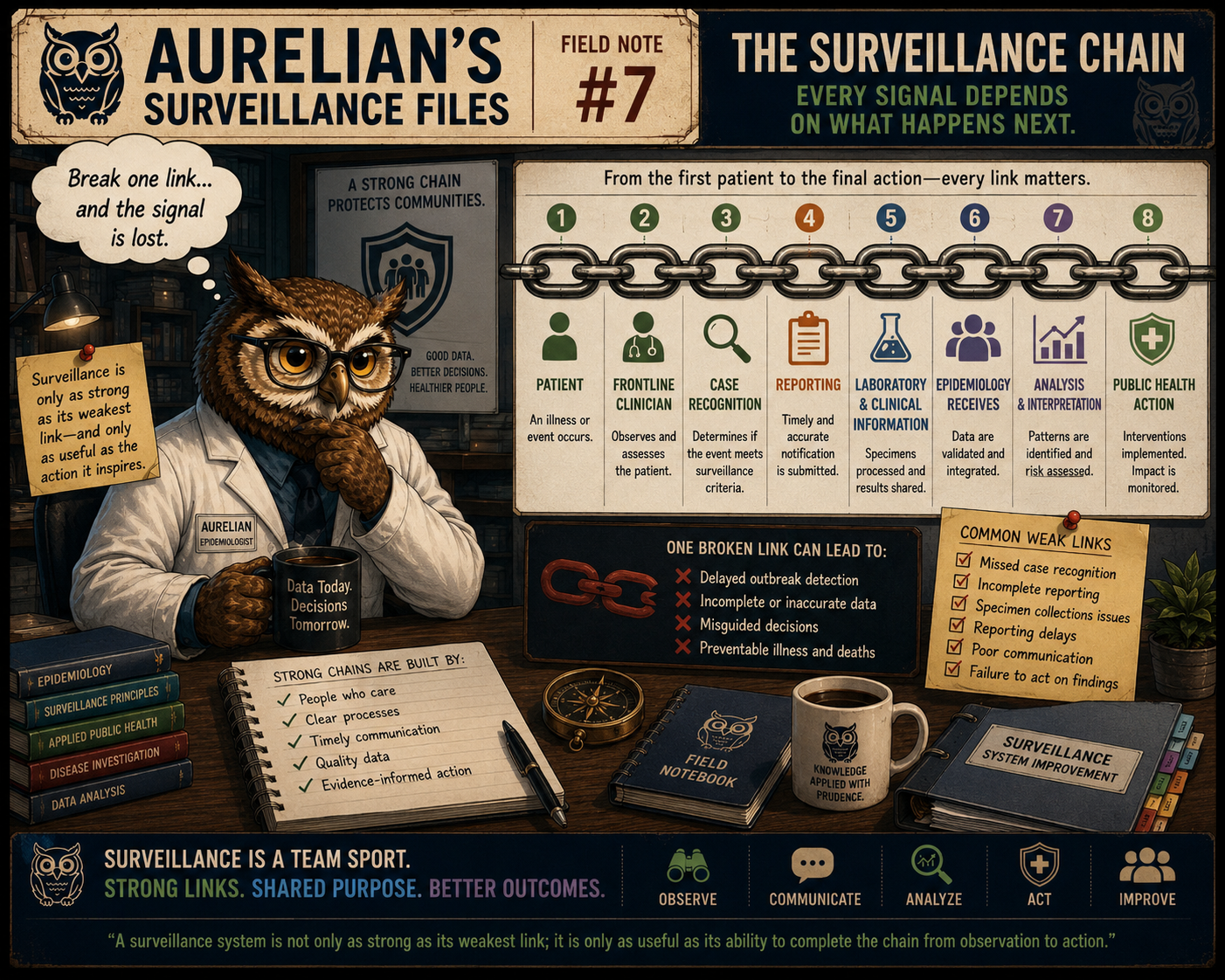
Surveillance systems rarely fail because a single link breaks. They fail because, over time, we allow the chain to rust
Last week, we explored sentinel surveillance and why effective surveillance is less about watching everything than about watching the right things.
This week, I want to step back from individual surveillance methods and look at something more fundamental.
After years working in hospital epidemiology, one lesson has remained with me.
Surveillance is not a report.
It is not a laboratory result.
It is not a dashboard.
It is not even the epidemiologist.
It is a chain.
And every signal depends on the strength of the next link.
The Myth of the Single Failure
Whenever an outbreak is detected late or an important event is missed, the same question often follows.
Who failed?
Was it the physician?
The laboratory?
The epidemiologist?
The hospital?
The public health authority?
Experience has taught me that this is usually the wrong question.
Surveillance systems rarely collapse because of one dramatic mistake.
More often, they weaken through a series of ordinary events.
A patient waits another day before seeking care.
A clinician treats the illness but does not recognize its public health significance.
A report is submitted late.
A laboratory result sits unnoticed in an inbox.
An epidemiologist focuses on yesterday’s indicators instead of today’s emerging pattern.
Communication slows.
Action waits.
None of these events seems especially serious on its own.
Together, they may be enough to delay the recognition of an outbreak.
Every Link Matters
When people think about surveillance, they often picture dashboards, statistical analyses, and epidemiologists reviewing trends.
In reality, the chain begins much earlier.
It begins with a patient.
Someone becomes ill.
Someone decides whether to seek care.
A clinician evaluates the patient.
Someone recognizes that the event may have public health significance.
The case is reported.
Laboratory findings support the investigation.
The data are reviewed and interpreted.
Patterns begin to emerge.
Public health action follows.
Each step depends on the one before it.
Remove one link and the signal weakens.
Remove several, and it may disappear altogether.
Rust Is More Dangerous Than Weakness
People often say,
“A chain is only as strong as its weakest link.”
There is truth in that.
But over the years I have come to believe something else.
Most chains are not built weak.
They are simply neglected.
Rust develops quietly.
A missed report.
A delayed notification.
An incomplete investigation.
A conversation that never takes place.
A surveillance meeting cancelled because everyone is busy.
A quality indicator no one reviews anymore.
None of these events attracts much attention.
Yet, over time, they accumulate.
The chain still looks intact.
Until the day it is asked to carry more than it can bear.
Shared Responsibility
There is a memorable exchange in The Godfather Part II between Michael Corleone and Senator Pat Geary.
At one point Michael says,
“We’re both part of the same hypocrisy, Senator.”
The conversation has nothing to do with epidemiology, yet that line has stayed with me.
When surveillance systems struggle, it is tempting to separate people into those who care and those who do not.
Reality is rarely so simple.
Physicians work under relentless pressure.
Nurses manage impossible workloads.
Laboratories operate with limited resources.
Administrators balance competing priorities.
Public health agencies face financial constraints.
Patients delay seeking care because they hope tomorrow will be better.
And epidemiologists—myself included—can become so focused on expected indicators that we overlook the unexpected signal.
We all work within the same system.
If that system becomes stronger, we all benefit.
If it weakens, we all share the consequences.
Surveillance Is a Collective Effort
One misconception persists in public health.
That surveillance belongs to epidemiologists.
It does not.
Clinicians recognize unusual presentations.
Nurses notice changing patterns.
Laboratory professionals confirm diagnoses.
Health information teams protect data quality.
Hospital leaders provide the resources that make surveillance possible.
Public health practitioners connect information across institutions.
Patients contribute by seeking care promptly and sharing accurate information.
The epidemiologist does not own the system.
The epidemiologist helps connect its many parts.
Ownership Matters More Than Blame
Blame asks,
Who made the mistake?
Ownership asks,
What can we do differently next time?
That distinction matters.
Organizations that focus on blame often repeat the same failures.
Organizations that examine their processes usually emerge stronger.
When surveillance breaks down, the most useful questions are seldom personal.
Where did communication stop?
Where did information slow?
Which part of the process needs attention?
Those are the questions that strengthen a surveillance system.
Key Takeaways
- Surveillance is a connected process, not a single activity.
- Every step, from the patient to public health action, depends on the one before it.
- Most surveillance failures arise from several small breakdowns rather than one dramatic error.
- Systems deteriorate gradually when communication, feedback, and routine evaluation are neglected.
- Strong surveillance depends on shared responsibility rather than individual blame.
A Final Thought
One lesson has remained with me throughout my career.
Every surveillance system requires maintenance.
Not because people are careless.
Because healthcare is demanding.
We all become busy.
We all settle into routines.
We all assume someone else will notice what we have missed.
That is how rust begins.
Strong surveillance asks something more of us.
Curiosity.
Communication.
Humility.
A willingness to keep improving.
Every day, healthcare professionals walk into hospitals with the same purpose: to care for others.
Physicians.
Nurses.
Laboratory scientists.
Infection preventionists.
Epidemiologists.
Administrators.
Public health practitioners.
None of us begins the day intending to weaken the chain.
Yet intentions alone do not maintain surveillance systems.
Deliberate attention does.
Our responsibility is to strengthen the chain before the next emergency reminds us how much every link matters.
Surveillance does not end when a report is submitted.
It ends only when information leads to action.
At Prudentia Analytics, we believe that knowledge fulfills its purpose only when it is applied with prudence.
References
- Centers for Disease Control and Prevention. Principles of Epidemiology in Public Health Practice.
- World Health Organization. Public Health Surveillance.
- Centers for Disease Control and Prevention. Updated Guidelines for Evaluating Public Health Surveillance Systems.
- World Health Organization. Early Detection, Assessment and Response to Acute Public Health Events.
Related Field NotesRelated Field Notes
- Field Note #1 — Surveillance vs. Research: Same Data, Different Purpose
- Field Note #2 — Epidemiologic Silence: When No Reports Do Not Mean No Disease
- Field Note #3 — Case Definitions Evolve: Good Surveillance Adapts to New Evidence
- Field Note #4 — Syndromic Surveillance: Seeing the Pattern Before Knowing the Diagnosis
- Field Note #5 — Active vs. Passive Surveillance: Sometimes the Best Surveillance Happens Away from the Desk
- Field Note #6 — Sentinel Surveillance: You Don’t Need to Watch Everything—You Need to Watch the Right Things
Discussion
Every surveillance system depends on people as much as it depends on technology.
In your experience, which link in the surveillance chain is most vulnerable—not because people lack commitment, but because the system quietly allows rust to accumulate?